Power Platform vs Full Stack Development: Which Career Offers Better Salary and Growth? (2026 Guide)
Introduction
Choosing the right technology stack is one of the biggest career decisions for students, fresh graduates, and software professionals. Among today’s most popular career paths, Microsoft Power Platform and Full Stack Development stand out as two of the most rewarding options.
Both fields offer excellent salaries, global job opportunities, and long-term career growth. However, they cater to different skill sets, learning styles, and business needs.
So, which one should you choose in 2026?
In this comprehensive guide, we’ll compare Power Platform vs Full Stack Development across salary, demand, learning curve, job roles, future scope, certifications, and career progression to help you make an informed decision.
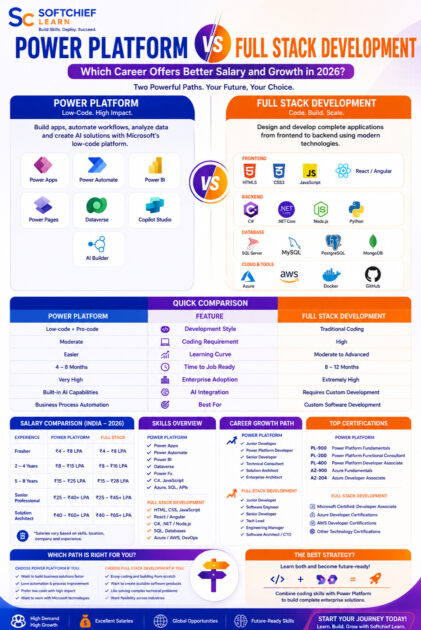
Understanding Power Platform
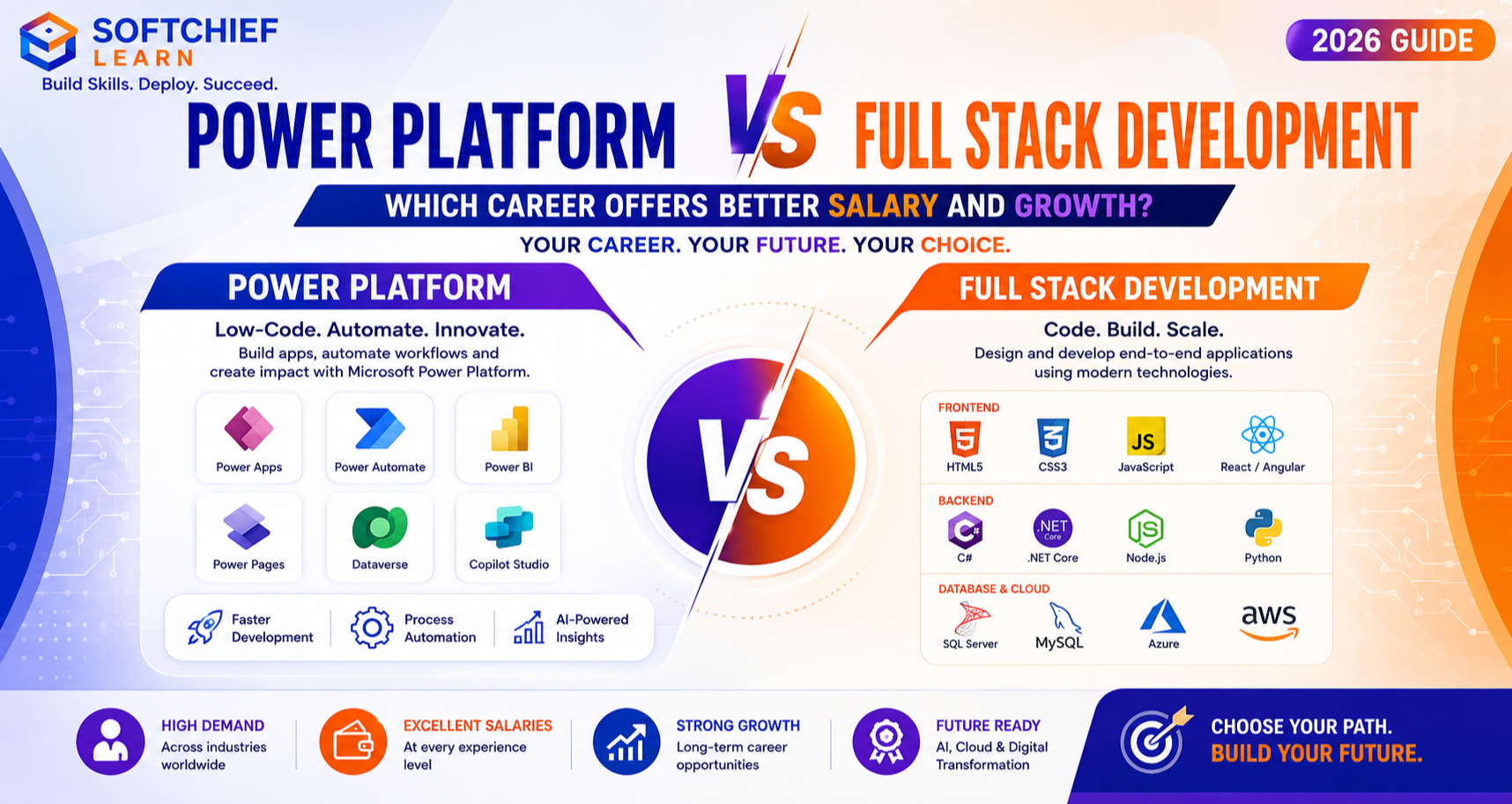
Microsoft Power Platform is a suite of low-code and AI-powered tools that enables organizations to build applications, automate workflows, analyze business data, and create AI assistants with minimal coding.
The platform includes:
- Power Apps
- Power Automate
- Power BI
- Power Pages
- Microsoft Dataverse
- Copilot Studio
- AI Builder
Power Platform is widely used by enterprises for rapid digital transformation and business process automation.
Understanding Full Stack Development
Full Stack Development involves building complete web applications, including both the frontend and backend.
A Full Stack Developer typically works with:
Frontend
- HTML5
- CSS3
- JavaScript
- TypeScript
- React
- Angular
- Vue.js
Backend
- C#
- ASP.NET Core
- Java
- Node.js
- Python
- PHP
Database
- SQL Server
- MySQL
- PostgreSQL
- MongoDB
Cloud
- Microsoft Azure
- AWS
- Google Cloud
Full Stack Developers build scalable software products from scratch.
Power Platform vs Full Stack Development: Quick Comparison
| Feature | Power Platform | Full Stack Development |
|---|---|---|
| Development Style | Low-code + Pro-code | Traditional Coding |
| Coding Requirement | Moderate | High |
| Learning Curve | Easier | Moderate to Advanced |
| Time to Become Job Ready | 4–8 Months | 8–12 Months |
| Enterprise Adoption | Very High | Extremely High |
| Startup Demand | Moderate | Very High |
| Cloud Integration | Excellent | Excellent |
| AI Integration | Built-in | Requires Custom Development |
| Business Process Automation | Excellent | Requires Development |
| Best For | Business Applications | Custom Software Development |
What Skills Do You Need?
Skills Required for Power Platform
Developers working with Microsoft Power Platform should learn:
- Power Apps
- Power Automate
- Power BI
- Power Pages
- Microsoft Dataverse
- Copilot Studio
- AI Builder
- Power Fx
- C#
- JavaScript
- SQL Server
- REST APIs
- Azure Fundamentals
Although Power Platform is a low-code platform, experienced developers often use C#, JavaScript, and Azure to build advanced enterprise solutions.
Skills Required for Full Stack Development
A Full Stack Developer typically needs expertise in:
- HTML
- CSS
- JavaScript
- React or Angular
- C#/.NET or Node.js
- ASP.NET Core
- SQL Server
- Entity Framework
- REST APIs
- Git & GitHub
- Azure or AWS
- Docker
- CI/CD
The learning path is broader because it covers multiple technologies.
Learning Curve
Power Platform
The Power Platform learning curve is generally faster because Microsoft provides visual development tools, reusable components, and built-in integrations.
Most learners can build business applications within a few weeks of consistent practice.
Full Stack Development
Full Stack Development requires a stronger understanding of programming concepts, architecture, frontend frameworks, backend development, database design, authentication, deployment, and testing.
Becoming proficient often takes longer but provides deeper software engineering knowledge.
Job Roles
Power Platform Careers
Common roles include:
- Power Platform Developer
- Power Apps Developer
- Power Automate Developer
- Power BI Developer
- Microsoft Consultant
- Dynamics 365 Developer
- Functional Consultant
- Technical Consultant
- Solution Architect
- AI Automation Consultant
Full Stack Careers
Popular job roles include:
- Full Stack Developer
- Software Engineer
- Backend Developer
- Frontend Developer
- Web Developer
- Cloud Developer
- API Developer
- Senior Software Engineer
- Technical Lead
- Software Architect
Salary Comparison (India – 2026)
Salary depends on skills, certifications, project experience, company size, and location. The following ranges are indicative:
| Experience | Power Platform | Full Stack Development |
|---|---|---|
| Fresher | ₹4 – ₹8 LPA | ₹4 – ₹8 LPA |
| 2–4 Years | ₹8 – ₹15 LPA | ₹8 – ₹16 LPA |
| 5–8 Years | ₹15 – ₹25 LPA | ₹15 – ₹28 LPA |
| Senior Professional | ₹25 – ₹40+ LPA | ₹25 – ₹45+ LPA |
| Solution Architect | ₹40 – ₹60+ LPA | ₹40 – ₹65+ LPA |
Key Insight: While salary ranges overlap, professionals with strong expertise, certifications, and enterprise project experience can earn significantly more in either domain.
Global Demand
Power Platform Demand
Demand continues to rise because organizations want to:
- Digitize business processes
- Reduce development costs
- Build applications quickly
- Automate repetitive tasks
- Integrate AI into business workflows
Industries adopting Power Platform include:
- Banking
- Insurance
- Healthcare
- Manufacturing
- Retail
- Government
- Education
- Logistics
Full Stack Demand
Full Stack Developers remain essential because organizations continue to build:
- SaaS products
- E-commerce platforms
- Enterprise portals
- Mobile backends
- Cloud-native applications
- Custom software solutions
Both careers have excellent global demand, but the type of work differs.
Which Career Is Easier to Learn?
Choose Power Platform if you:
- Prefer business application development
- Want to become job-ready faster
- Enjoy process automation
- Like working with Microsoft technologies
- Want to combine low-code with AI capabilities
Choose Full Stack Development if you:
- Enjoy programming
- Want to build software from scratch
- Like solving algorithmic problems
- Want flexibility across industries and technology stacks
Career Growth
Power Platform Growth Path
A typical progression is:
- Power Platform Intern
- Junior Developer
- Power Platform Developer
- Senior Developer
- Technical Consultant
- Solution Architect
- Enterprise Architect
Professionals can also transition into Dynamics 365, Azure, and AI consulting.
Full Stack Growth Path
Typical progression includes:
- Junior Full Stack Developer
- Software Engineer
- Senior Developer
- Technical Lead
- Engineering Manager
- Software Architect
- CTO (depending on organization)
Certifications
Recommended Microsoft Certifications
For Power Platform professionals:
- Microsoft Certified: Power Platform Fundamentals (PL-900)
- Microsoft Certified: Power Platform Functional Consultant (PL-200)
- Microsoft Certified: Power Platform Developer Associate (PL-400)
- Azure Fundamentals (AZ-900)
- Azure Developer Associate (AZ-204)
These certifications validate practical skills and strengthen your resume.
Which Career Is More Future-Proof?
Both careers are expected to remain relevant, but their growth drivers differ.
Power Platform
Growth is fueled by:
- Enterprise digital transformation
- AI-powered automation
- Microsoft Copilot
- Business application modernization
- Low-code adoption
Full Stack Development
Growth is driven by:
- Web applications
- SaaS products
- Cloud-native software
- Enterprise development
- Mobile and API ecosystems
Rather than replacing each other, these fields increasingly complement one another.
Can You Learn Both?
Absolutely—and this combination is becoming highly valuable.
A developer with skills in:
- C#
- ASP.NET Core
- SQL Server
- Azure
- Power Apps
- Power Automate
- Dataverse
- Power Pages
- REST APIs
can build custom software while rapidly delivering enterprise business applications.
Many Microsoft consulting companies actively seek professionals with expertise in both traditional development and the Power Platform ecosystem.
Which Career Is Best for Freshers?
Choose Power Platform if:
- You want a faster entry into enterprise IT.
- You enjoy solving business problems.
- You prefer Microsoft’s ecosystem.
- You are interested in automation and AI.
Choose Full Stack Development if:
- You enjoy writing code every day.
- You want to build products from the ground up.
- You like frontend and backend development.
- You aim for software engineering roles across diverse industries.
Common Mistakes to Avoid
Regardless of the path you choose:
- Learning tools without understanding programming fundamentals
- Ignoring SQL and databases
- Avoiding cloud technologies
- Building certifications without practical projects
- Neglecting communication and problem-solving skills
- Failing to create a GitHub or project portfolio
Real-world experience is often the deciding factor during interviews.
Suggested Learning Roadmaps
Power Platform Roadmap
- Learn Power Apps
- Master Power Automate
- Understand Dataverse
- Learn Power BI
- Explore Power Pages
- Study Copilot Studio and AI Builder
- Learn C#, JavaScript, SQL, and Azure
- Build enterprise projects
- Earn Microsoft certifications
- Prepare for interviews
Full Stack Development Roadmap
- HTML & CSS
- JavaScript & TypeScript
- React or Angular
- C# with ASP.NET Core
- SQL Server
- Entity Framework
- REST APIs
- Azure Cloud
- Git & CI/CD
- Deploy full-stack applications
Final Verdict
There is no universal “best” career—only the one that aligns with your interests and goals.
Choose Power Platform if you want to specialize in enterprise applications, automation, and Microsoft’s rapidly growing low-code and AI ecosystem. It offers a shorter learning curve, strong enterprise demand, and excellent opportunities in consulting.
Choose Full Stack Development if you enjoy software engineering, coding complex applications, and building products from scratch. It provides broad technical exposure and flexibility across industries.
For many aspiring professionals, the strongest career strategy is not choosing one over the other but combining them. A developer skilled in C#, .NET, Azure, SQL Server, and Microsoft Power Platform is well-positioned to deliver complete business solutions and stand out in today’s competitive job market.
Conclusion
Power Platform and Full Stack Development are not competing technologies—they solve different business challenges and increasingly work together in modern enterprise environments. Organizations need professionals who can build scalable applications, automate workflows, integrate cloud services, and leverage AI to improve business outcomes.
If you’re beginning your career, focus on mastering one path first, build real-world projects, earn relevant certifications, and continuously expand your expertise. Whether you choose Power Platform, Full Stack Development, or a combination of both, consistent learning and practical experience will be the key to long-term career success.