How to Build Scalable Microservices Using ASP.NET Core
Introduction
Modern businesses demand software that is always available, scales effortlessly and evolves quickly to meet changing customer expectations. Whether it’s an e-commerce platform handling millions of orders, a banking application processing real-time transactions or a SaaS product serving users across multiple regions, applications must be designed to handle increasing workloads without compromising performance or reliability.
For years, many organizations relied on monolithic architectures, where all business functionality was built into a single application. While this approach works well for smaller projects, it often becomes difficult to maintain as systems grow. A single codebase can slow development, complicate deployments and create a single point of failure.
This is why many organizations are embracing microservices architecture.
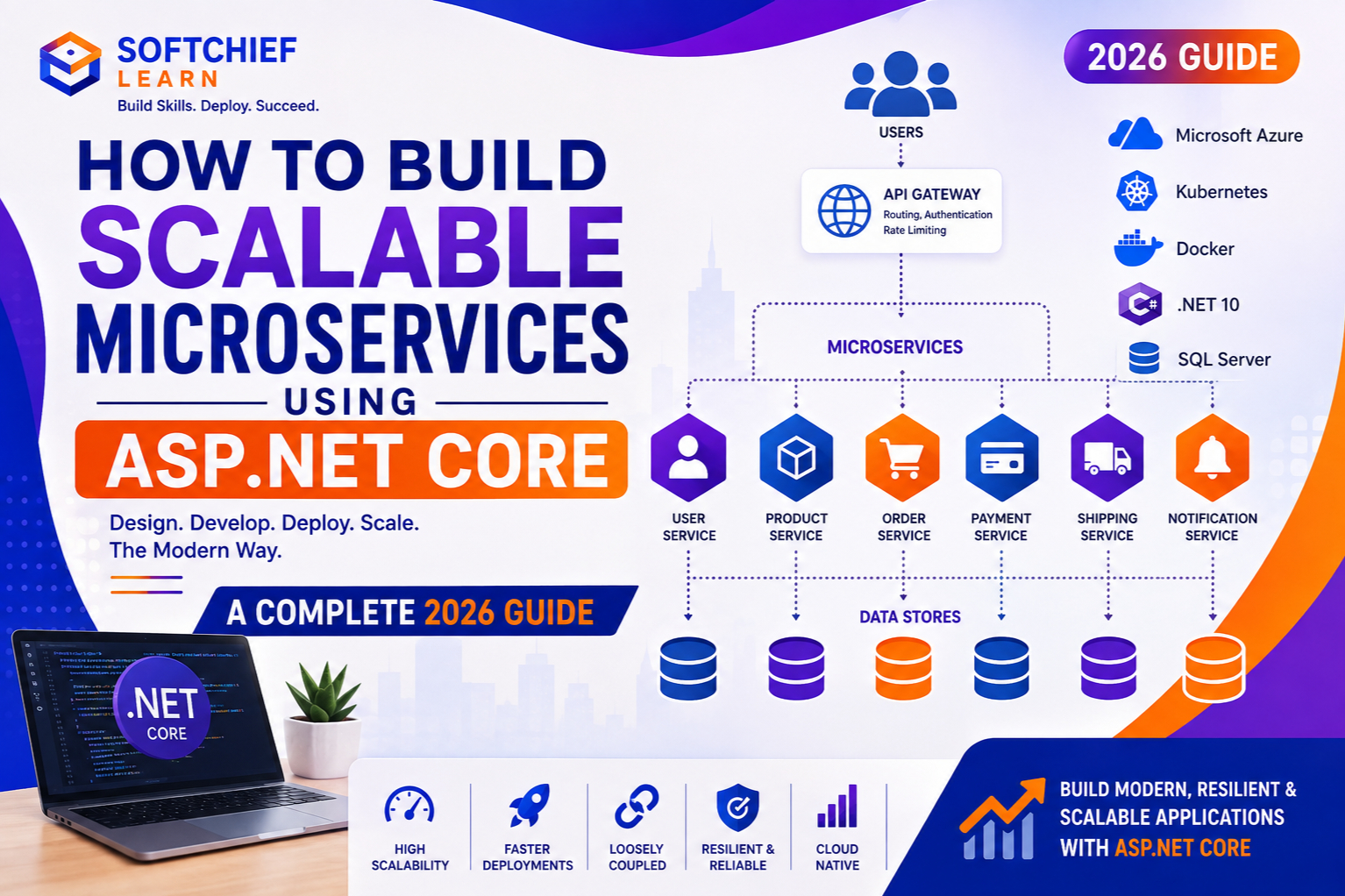
Microservices break large applications into smaller, independent services that can be developed, deployed and scaled individually. Combined with the power of ASP.NET Core, developers can create high-performance, cloud-native applications that are resilient, maintainable and ready for enterprise-scale workloads.
In this comprehensive guide, you’ll learn how to build scalable microservices using ASP.NET Core, understand key architectural principles, explore essential tools and discover industry best practices for 2026.
What Are Microservices?
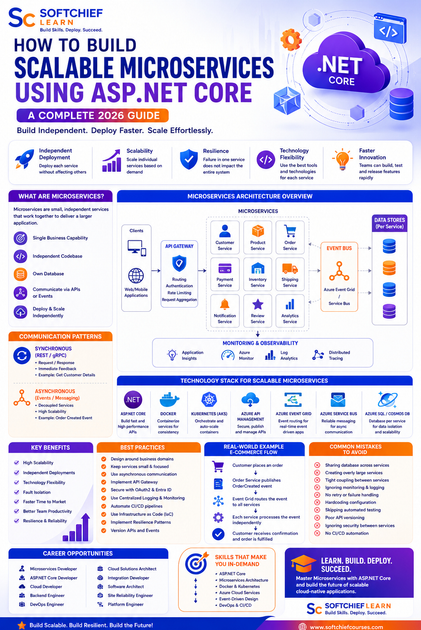
Microservices are an architectural style in which an application is composed of multiple small, independent services.
Each microservice:
- Focuses on a single business capability.
- Has its own codebase.
- Can be deployed independently.
- Owns its own data.
- Communicates with other services using APIs or messaging.
- Can scale independently.
Unlike monolithic applications, microservices allow teams to work on different services simultaneously without affecting the entire application.
Why Choose ASP.NET Core for Microservices?
ASP.NET Core is one of the most popular frameworks for building microservices due to its performance, flexibility and cloud-native capabilities.
Key advantages include:
- High performance
- Cross-platform support
- Lightweight architecture
- Built-in dependency injection
- Minimal APIs
- Excellent REST API support
- Native container support
- Cloud readiness
- Rich middleware pipeline
- Seamless Azure integration
Its modular design makes it ideal for building distributed systems.
Monolithic vs Microservices Architecture
Understanding the differences helps determine the right approach.
| Feature | Monolithic Architecture | Microservices Architecture |
|---|---|---|
| Deployment | Single application | Independent services |
| Scalability | Entire application | Individual services |
| Technology Stack | Usually one | Can vary by service |
| Database | Shared | Database per service |
| Fault Isolation | Low | High |
| Team Collaboration | Limited | High |
| Release Cycle | Slower | Faster |
| Maintenance | Becomes complex over time | Easier when properly designed |
While monoliths may suit smaller projects, microservices offer greater flexibility for large and evolving systems.
Core Principles of Microservices
Successful microservices share several key characteristics:
- Single Responsibility Principle
- Loose coupling
- High cohesion
- Independent deployment
- Decentralized data management
- API-first design
- Fault tolerance
- Automation
- Observability
- Scalability
These principles help create systems that are easier to evolve over time.
Designing Microservices Around Business Domains
Rather than dividing services by technical layers, design them around business capabilities.
For an online retail platform, services might include:
- Customer Service
- Product Service
- Inventory Service
- Order Service
- Payment Service
- Shipping Service
- Notification Service
- Review Service
Each service owns its business logic and data, reducing dependencies between teams.
Choosing the Right Communication Style
Microservices communicate in two primary ways.
Synchronous Communication
Typically uses REST APIs or gRPC.
Examples:
- Retrieve customer details
- Validate product availability
- Fetch account information
Best suited for request-response scenarios where immediate feedback is required.
Asynchronous Communication
Uses messaging platforms such as:
- Azure Service Bus
- Azure Event Grid
- RabbitMQ
- Apache Kafka
Examples:
- Order placed
- Payment completed
- Invoice generated
- Shipment dispatched
Asynchronous communication improves scalability and resilience by reducing direct dependencies between services.
Building RESTful APIs with ASP.NET Core
Each microservice typically exposes REST APIs for external communication.
Well-designed APIs should:
- Follow REST principles.
- Use meaningful resource names.
- Return appropriate HTTP status codes.
- Validate input consistently.
- Support versioning.
- Provide structured error responses.
- Include OpenAPI (Swagger) documentation.
Clear API contracts simplify integration and maintenance.
Using Minimal APIs for Lightweight Services
ASP.NET Core Minimal APIs reduce boilerplate code for simple microservices.
They are ideal for:
- Internal services
- Lightweight APIs
- Serverless endpoints
- Prototype applications
For larger services with complex business logic, traditional controllers may provide better organization.
Database Per Microservice
One of the defining principles of microservices is that each service owns its data.
Examples:
Order Service
- Orders Database
Customer Service
- Customer Database
Inventory Service
- Inventory Database
This approach avoids tight coupling and allows each service to evolve independently.
API Gateway
An API Gateway acts as the single entry point for client applications.
Benefits include:
- Authentication
- Authorization
- Request routing
- Rate limiting
- SSL termination
- Logging
- Response aggregation
Popular options include:
- Azure API Management
- YARP (Yet Another Reverse Proxy)
- Ocelot
- NGINX
An API Gateway simplifies client interactions and centralizes cross-cutting concerns.
Implementing Authentication and Authorization
Security is critical in distributed systems.
Recommended approaches include:
- Microsoft Entra ID
- OAuth 2.0
- OpenID Connect
- JWT Bearer Tokens
- Role-Based Access Control (RBAC)
- Policy-based authorization
Avoid sharing credentials between services. Instead, use secure token-based authentication and managed identities where possible.
Containerizing Microservices with Docker
Containers package applications together with their dependencies, ensuring consistency across environments.
Benefits include:
- Environment consistency
- Faster deployments
- Easy scaling
- Simplified testing
- Better resource utilization
Each ASP.NET Core microservice should have its own Docker image built through an automated CI/CD pipeline.
Orchestrating Containers with Kubernetes
As the number of microservices grows, container orchestration becomes essential.
Azure Kubernetes Service (AKS) provides:
- Automatic scaling
- Load balancing
- Self-healing
- Rolling updates
- Service discovery
- Secret management
- High availability
Kubernetes enables organizations to manage large-scale microservices efficiently.
Service Discovery
Microservices frequently change locations as they scale.
Service discovery allows services to find each other dynamically without hardcoded addresses.
Options include:
- Kubernetes DNS
- Azure Container Apps
- Consul
- Azure Service Fabric
Dynamic discovery simplifies deployment and improves resilience.
Event-Driven Architecture
Modern microservices often adopt an event-driven approach.
Example:
When an order is placed:
- Order Service publishes an
OrderCreatedevent. - Payment Service processes payment.
- Inventory Service reserves stock.
- Shipping Service prepares delivery.
- Notification Service informs the customer.
- Analytics Service updates dashboards.
Each service responds independently, improving scalability and fault isolation.
Implementing Resilience
Distributed systems must handle failures gracefully.
ASP.NET Core applications should implement:
- Retry policies
- Circuit breakers
- Timeouts
- Bulkheads
- Fallback mechanisms
Libraries such as Polly simplify resilience implementation and improve application reliability.
Centralized Logging
With multiple services, centralized logging becomes essential.
Recommended solutions include:
- Azure Monitor
- Application Insights
- Serilog
- Elastic Stack (ELK)
- OpenTelemetry
Logs should include correlation IDs to trace requests across services.
Monitoring and Observability
Beyond logging, teams need comprehensive observability.
Monitor:
- Response times
- Error rates
- CPU utilization
- Memory consumption
- API latency
- Message queue lengths
- Deployment health
Combining metrics, logs and distributed tracing helps identify issues quickly.
Continuous Integration and Continuous Deployment (CI/CD)
Automate software delivery using Azure DevOps or GitHub Actions.
Typical pipeline stages include:
- Code validation
- Build
- Unit testing
- Security scanning
- Docker image creation
- Container registry publishing
- Deployment to Kubernetes
- Automated smoke testing
Automation reduces deployment errors and accelerates release cycles.
Infrastructure as Code (IaC)
Cloud infrastructure should be managed through code rather than manual configuration.
Common IaC tools include:
- Bicep
- ARM Templates
- Terraform
Benefits include:
- Repeatable deployments
- Version control
- Easier collaboration
- Faster disaster recovery
- Reduced configuration drift
Real-World Scenario
Imagine a global online marketplace serving millions of customers.
The architecture includes:
- Customer Service
- Product Service
- Search Service
- Cart Service
- Order Service
- Payment Service
- Shipping Service
- Recommendation Service
- Notification Service
Each service:
- Runs in its own Docker container.
- Is deployed to Azure Kubernetes Service.
- Stores data in its own database.
- Communicates through Azure Event Grid and Azure Service Bus.
- Exposes secure APIs through Azure API Management.
- Is monitored using Azure Monitor and Application Insights.
As customer demand increases during seasonal sales, only the services under heavy load—such as the Order and Payment Services—scale independently, optimizing resource usage and maintaining performance.
Common Mistakes to Avoid
Many teams encounter challenges by:
- Sharing a single database across services.
- Creating services that are too small or too large.
- Building tightly coupled APIs.
- Ignoring observability.
- Skipping automated testing.
- Hardcoding configuration values.
- Neglecting security between services.
- Deploying without CI/CD.
- Avoiding Infrastructure as Code.
- Failing to document APIs and event contracts.
Avoiding these mistakes leads to more maintainable and resilient systems.
Best Practices for Building Scalable Microservices
To build successful ASP.NET Core microservices:
- Design services around business capabilities rather than technical layers.
- Keep each service focused on a single responsibility.
- Prefer asynchronous messaging for long-running or decoupled workflows.
- Use API versioning to support backward compatibility.
- Containerize every service with Docker.
- Orchestrate deployments using Kubernetes or Azure Container Apps.
- Secure APIs with Microsoft Entra ID and OAuth 2.0.
- Implement resilience patterns such as retries and circuit breakers.
- Centralize logging and monitoring using Azure Monitor and OpenTelemetry.
- Automate builds, testing and deployments with Azure DevOps or GitHub Actions.
Career Opportunities
As organizations continue adopting cloud-native architectures, professionals skilled in ASP.NET Core microservices are in high demand.
Career paths include:
- ASP.NET Core Developer
- Backend Software Engineer
- Cloud Developer
- Azure Developer
- Microservices Architect
- Cloud Solutions Architect
- DevOps Engineer
- Platform Engineer
- Integration Developer
- Enterprise Application Architect
Expertise in microservices, Docker, Kubernetes, Azure and distributed systems significantly enhances career prospects.
Learn ASP.NET Core Microservices with Softchief Learn
At Softchief Learn, we offer comprehensive, hands-on training to help developers master modern application architecture using Microsoft’s latest technologies.
Our learning programs include:
- C# Programming
- ASP.NET Core
- .NET 10 Development
- RESTful API Development
- Minimal APIs
- Microservices Architecture
- Azure Service Bus
- Azure Event Grid
- Docker
- Kubernetes (AKS)
- Azure API Management
- Azure DevOps
- GitHub Actions
- Microsoft Entra ID
- OpenTelemetry
- Azure Monitor
- Live Projects and Enterprise Case Studies
- Microsoft Certification Preparation
Our expert-led training combines practical exercises, real-world implementation scenarios and interview preparation to help learners become confident cloud developers and solution architects.
Conclusion
Microservices architecture has become the preferred approach for building scalable, resilient and cloud-native applications. By leveraging ASP.NET Core, developers can create high-performance services that are independently deployable, easy to maintain and capable of evolving alongside changing business needs.
When combined with technologies such as Docker, Kubernetes, Azure Event Grid, Azure Service Bus, Azure API Management and Azure DevOps, ASP.NET Core provides a powerful ecosystem for developing enterprise-grade distributed systems.
Building scalable microservices requires more than choosing the right framework—it involves thoughtful service design, secure communication, automated deployments, observability and resilience. By following the principles and best practices outlined in this guide, developers can create applications that are well-equipped to meet the demands of modern software development in 2026 and beyond.