Azure Developer vs Azure Administrator: Which Azure Career Path Should You Choose in 2026?
Introduction
Cloud computing has become the backbone of modern businesses, and Microsoft Azure continues to be one of the world’s leading cloud platforms. As organizations migrate applications, data, and infrastructure to the cloud, the demand for Azure professionals has never been higher.
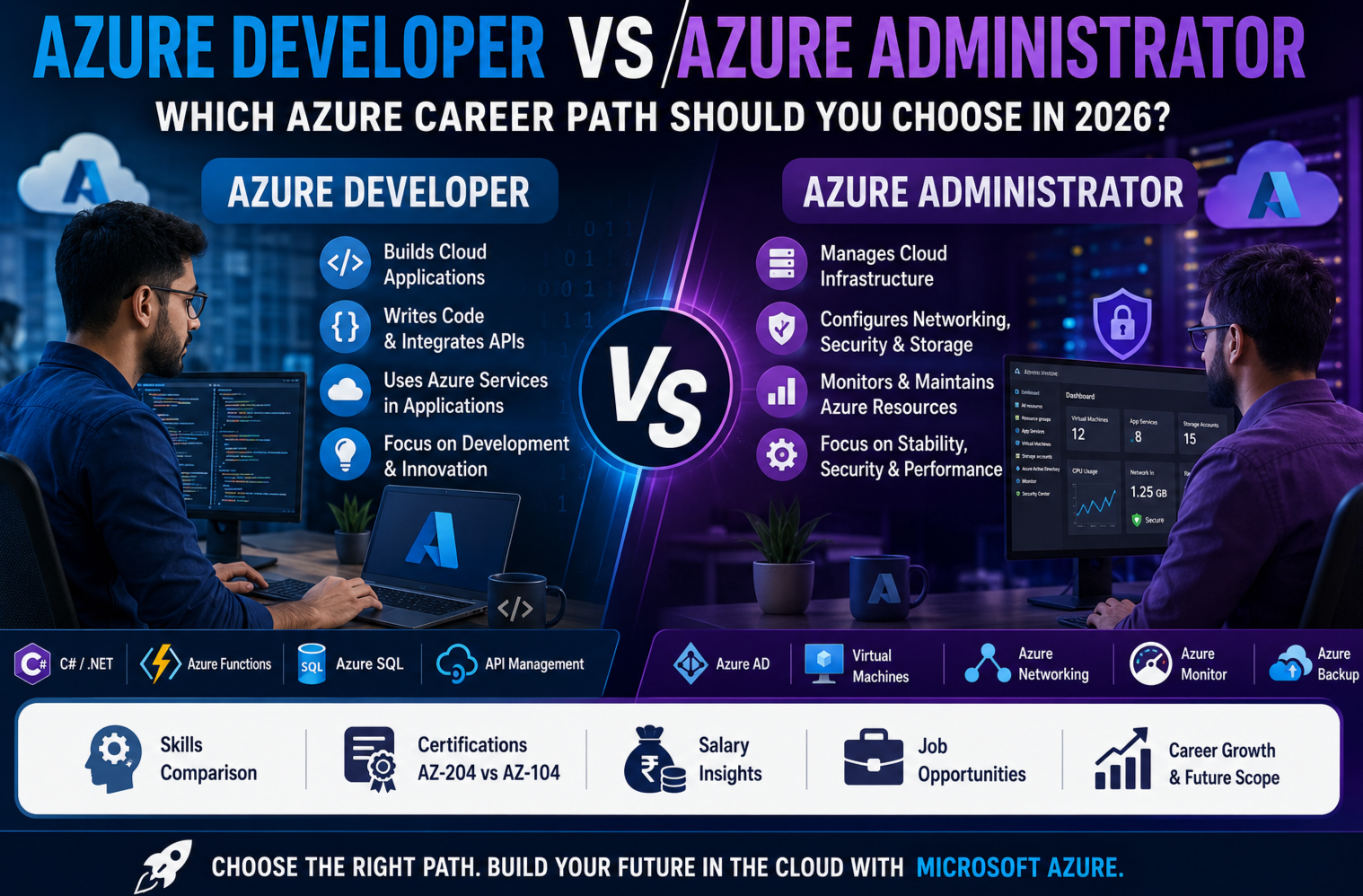
Two of the most sought-after career paths in the Azure ecosystem are Azure Developer and Azure Administrator. While both roles work with Microsoft Azure, their responsibilities, required skills, and career trajectories are significantly different.
If you’re planning a career in cloud computing or looking to specialize in Microsoft technologies, this guide will help you understand the key differences and determine which path best suits your interests and goals.
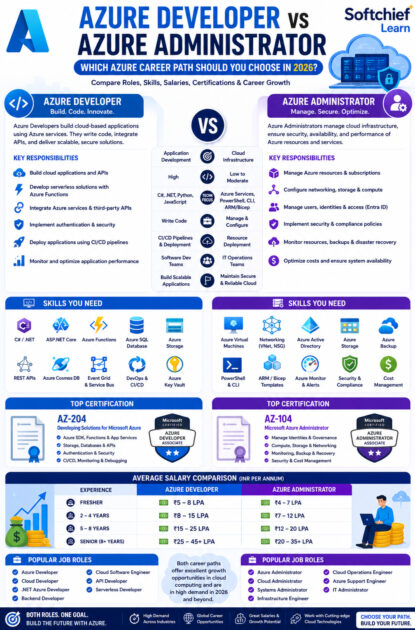
What is Microsoft Azure?
Microsoft Azure is Microsoft’s cloud computing platform that provides over 200 cloud services for building, deploying, managing, and scaling applications through Microsoft’s global network of data centers.
Azure services cover:
- Virtual Machines
- App Services
- Azure Functions
- Azure Kubernetes Service (AKS)
- Azure SQL Database
- Azure Storage
- Azure Active Directory (Microsoft Entra ID)
- Networking
- AI & Machine Learning
- DevOps Services
- Security & Identity
- Data Analytics
Today, organizations of all sizes rely on Azure for application hosting, cloud infrastructure, disaster recovery, analytics, artificial intelligence, and enterprise security.
Who is an Azure Developer?
An Azure Developer builds, deploys, and maintains cloud-native applications using Azure services. Their primary responsibility is writing code that leverages Azure’s cloud capabilities.
Azure Developers focus on application development rather than infrastructure management.
Typical responsibilities include:
- Building cloud-based applications
- Developing REST APIs
- Creating serverless applications
- Integrating Azure services
- Deploying applications
- Managing application security
- Implementing authentication
- Optimizing cloud applications
- Monitoring application performance
Their goal is to deliver scalable, secure, and high-performing applications.
Who is an Azure Administrator?
An Azure Administrator manages the Azure cloud environment, ensuring that infrastructure, networking, security, storage, and resources operate efficiently.
Instead of developing applications, Azure Administrators focus on maintaining the cloud platform.
Typical responsibilities include:
- Managing Azure Virtual Machines
- Configuring networking
- Managing Azure Storage
- User and identity management
- Implementing backup and disaster recovery
- Resource monitoring
- Security configuration
- Cost optimization
- Managing subscriptions
- Infrastructure automation
Their primary goal is ensuring cloud environments remain secure, available, and cost-effective.
Azure Developer vs Azure Administrator: Quick Comparison
| Feature | Azure Developer | Azure Administrator |
|---|---|---|
| Primary Focus | Application Development | Cloud Infrastructure |
| Coding Required | High | Low to Moderate |
| Programming Languages | C#, .NET, Java, Python, Node.js | PowerShell, Azure CLI, ARM/Bicep |
| Infrastructure Management | Basic | Extensive |
| Automation | Application Automation | Infrastructure Automation |
| Deployment | CI/CD Pipelines | Resource Deployment |
| Target Users | Software Development Teams | IT Operations Teams |
| Daily Work | Writing Code | Managing Cloud Resources |
| Learning Curve | Programming Intensive | Infrastructure Intensive |
Core Responsibilities
Azure Developer
An Azure Developer is responsible for:
Building Applications
- ASP.NET Core applications
- APIs
- Microservices
- Serverless applications
- Azure Functions
Cloud Integration
- Azure Storage
- Service Bus
- Event Grid
- Event Hub
- Azure SQL
- Cosmos DB
Security
- Microsoft Entra ID integration
- Managed Identities
- Key Vault
- OAuth
- Authentication & Authorization
Deployment
- Azure DevOps
- GitHub Actions
- CI/CD Pipelines
- Container Deployment
Azure Administrator
An Azure Administrator manages:
Compute
- Virtual Machines
- Scale Sets
- Availability Sets
- App Services
Networking
- Virtual Networks
- Load Balancers
- VPN Gateway
- Azure Firewall
- DNS
Identity
- Microsoft Entra ID
- RBAC
- Conditional Access
- Multi-Factor Authentication
Monitoring
- Azure Monitor
- Log Analytics
- Alerts
- Application Insights
Backup & Recovery
- Azure Backup
- Recovery Services Vault
- Disaster Recovery
- Business Continuity
Skills Required
Azure Developer Skills
A successful Azure Developer should have expertise in:
Programming
- C#
- .NET
- ASP.NET Core
- JavaScript
- TypeScript
- Python (optional)
- Java (optional)
Azure Services
- Azure Functions
- App Service
- Azure Storage
- Azure SQL
- Cosmos DB
- Service Bus
- Event Grid
- Azure API Management
DevOps
- Git
- Azure DevOps
- GitHub Actions
- Docker
- Kubernetes (AKS)
Security
- OAuth
- JWT
- Managed Identity
- Azure Key Vault
Azure Administrator Skills
Azure Administrators should master:
Compute
- Virtual Machines
- Virtual Machine Scale Sets
- Azure App Services
Networking
- VNets
- NSGs
- Azure Firewall
- VPN Gateway
- ExpressRoute
- DNS
Storage
- Blob Storage
- File Storage
- Disk Storage
- Backup
Identity
- Microsoft Entra ID
- RBAC
- Privileged Identity Management
- Conditional Access
Automation
- Azure CLI
- PowerShell
- ARM Templates
- Bicep
Programming Requirement
One of the biggest differences between these roles is coding.
Azure Developer
Requires strong programming knowledge.
You’ll regularly write:
- C#
- .NET APIs
- Azure Functions
- Event-driven code
- Microservices
- Backend services
Azure Administrator
Programming is not the primary responsibility.
Instead, you’ll automate tasks using:
- PowerShell
- Azure CLI
- Bicep
- ARM Templates
Basic scripting knowledge is usually sufficient.
Daily Work Comparison
Azure Developer
A typical day may involve:
- Writing application code
- Debugging APIs
- Deploying new features
- Integrating Azure services
- Fixing application bugs
- Optimizing cloud performance
Azure Administrator
A typical day may include:
- Creating Virtual Machines
- Configuring networking
- Monitoring resources
- Applying security policies
- Managing users
- Reviewing Azure costs
- Troubleshooting infrastructure issues
Certifications
Azure Developer Certification
AZ-204: Developing Solutions for Microsoft Azure
This certification validates skills in:
- Azure SDK
- Azure Functions
- Azure Storage
- Authentication
- APIs
- Event-driven development
- Monitoring
Ideal for software developers working with Azure.
Azure Administrator Certification
AZ-104: Microsoft Azure Administrator
This certification covers:
- Azure identities
- Governance
- Compute
- Storage
- Networking
- Monitoring
- Backup
- Resource management
Recommended for infrastructure and cloud administrators.
Salary Comparison
(Approximate salaries vary by country, employer, and experience.)
| Experience | Azure Developer | Azure Administrator |
|---|---|---|
| Fresher | ₹5–8 LPA | ₹4–7 LPA |
| 2–4 Years | ₹8–15 LPA | ₹7–12 LPA |
| 5–8 Years | ₹15–25 LPA | ₹12–20 LPA |
| Senior | ₹25–45+ LPA | ₹20–35+ LPA |
Professionals with expertise in DevOps, Kubernetes, security, and cloud architecture often command higher salaries in both roles.
Job Opportunities
Azure Developer Roles
- Azure Developer
- Cloud Developer
- .NET Azure Developer
- Cloud Software Engineer
- Backend Developer
- API Developer
- Serverless Developer
Industries hiring include:
- Banking
- Healthcare
- E-commerce
- SaaS
- Retail
- Manufacturing
- Government
Azure Administrator Roles
- Azure Administrator
- Cloud Administrator
- Infrastructure Engineer
- Cloud Operations Engineer
- Systems Administrator
- Azure Support Engineer
- Cloud Engineer
These roles are common across enterprises, managed service providers, consulting firms, and IT operations teams.
Which Role Has Better Future?
Both Azure Developers and Azure Administrators are expected to remain in high demand as cloud adoption continues to grow.
Azure Developer demand is increasing because:
- Organizations are building cloud-native applications.
- AI-powered applications require scalable cloud backends.
- Microservices and serverless architectures are becoming standard.
- Digital transformation initiatives continue across industries.
Azure Administrator demand remains strong because:
- Every Azure deployment requires secure and reliable infrastructure.
- Cloud governance and compliance are increasingly important.
- Businesses need experts to manage cost optimization and security.
- Hybrid cloud environments continue to expand.
Rather than competing, these roles complement each other within modern cloud teams.
Can You Transition Between Roles?
Yes. Many professionals move between Azure Administrator and Azure Developer roles as they expand their skills.
For example:
- An Azure Administrator who learns C#, .NET, and Azure Functions can transition into Azure Development.
- An Azure Developer who gains expertise in networking, security, governance, and infrastructure can move toward Cloud Engineering or Solution Architecture.
Professionals who understand both application development and cloud infrastructure are highly valued because they can design, deploy, and manage end-to-end Azure solutions.
Which Career Should You Choose?
Choose Azure Developer if you:
- Enjoy coding and software development.
- Want to build cloud-native applications.
- Like solving programming challenges.
- Are interested in APIs, microservices, and serverless computing.
- Have experience with C#, .NET, Java, Python, or JavaScript.
Choose Azure Administrator if you:
- Enjoy working with cloud infrastructure.
- Prefer configuring and managing systems rather than writing code.
- Are interested in networking, security, identity, and resource management.
- Like troubleshooting operational issues.
- Want to build expertise in cloud governance and infrastructure automation.
If your long-term goal is to become a Cloud Solution Architect, learning both development and administration provides a strong foundation.
Frequently Asked Questions (FAQs)
Which certification should I pursue first: AZ-104 or AZ-204?
If you’re interested in infrastructure, cloud management, and operations, start with AZ-104. If your focus is software development and cloud applications, AZ-204 is the better choice.
Does Azure Administrator require coding?
Not extensive coding. Basic scripting using PowerShell, Azure CLI, or Bicep is beneficial, but the role is primarily focused on infrastructure management.
Can a .NET developer become an Azure Developer?
Yes. In fact, C# and .NET developers often transition smoothly into Azure Development because many Azure services integrate closely with the .NET ecosystem.
Is Azure Developer a good career in 2026?
Yes. As businesses continue to adopt cloud-native architectures and AI-powered applications, Azure Developers remain among the most in-demand cloud professionals.
Which role pays more?
Both roles offer competitive salaries. Azure Developers may earn slightly higher salaries in software product companies due to their programming expertise, while Azure Administrators with advanced cloud, security, or DevOps skills can achieve comparable compensation.
Conclusion
Azure Developer and Azure Administrator are both essential roles in the Microsoft cloud ecosystem, but they cater to different strengths and career aspirations.
If you enjoy building applications, writing code, and developing cloud-native solutions, the Azure Developer path offers exciting opportunities in software engineering and cloud application development. If your interests lie in cloud infrastructure, networking, security, and operational excellence, Azure Administration provides a rewarding and future-proof career.
Many organizations seek professionals who can bridge both domains. Developing expertise in Azure development, infrastructure management, automation, and security can position you for advanced roles such as Cloud Engineer, DevOps Engineer, or Azure Solution Architect, making you an invaluable asset in today’s cloud-first world.