How Dynamics 365 Finance & Operations Improves Warehouse Management
Introduction
In today’s highly competitive business environment, efficient warehouse management has become a critical factor in supply chain success. Customers expect faster deliveries, accurate inventory availability and seamless order fulfillment. Businesses must manage increasing product volumes, multiple warehouses, complex logistics networks and changing customer demands while keeping operational costs under control.
Traditional warehouse processes often depend on manual operations, disconnected systems and limited visibility. These challenges can lead to:
- Inventory inaccuracies
- Delayed shipments
- Poor warehouse productivity
- Increased labour costs
- Stock shortages
- Excess inventory
- Order fulfillment errors
Modern enterprises need intelligent warehouse management solutions that automate operations, improve inventory visibility and optimize every movement within the warehouse.
This is where Microsoft Dynamics 365 Finance & Operations Warehouse Management delivers significant improvements.
Dynamics 365 Finance & Operations (D365 F&O) provides an advanced Warehouse Management System (WMS) designed to help organizations streamline receiving, storage, picking, packing, shipping and inventory control processes.
With capabilities such as mobile warehouse operations, automation, advanced tracking, AI-powered insights and real-time analytics, Dynamics 365 Finance & Operations enables businesses to build faster, smarter and more efficient warehouse operations.
In this expert guide, we will explore the key warehouse management improvements in Dynamics 365 Finance & Operations and how organizations can leverage these capabilities to optimize supply chain performance.
What is Warehouse Management in Dynamics 365 Finance & Operations?
Warehouse Management in Microsoft Dynamics 365 Finance & Operations is a comprehensive solution that helps businesses control and optimize warehouse activities from inbound receiving to outbound shipment.
It provides capabilities for:
- Inventory management
- Warehouse operations
- Location management
- Picking and packing
- Workload optimization
- Mobile warehouse execution
- Inventory movement tracking
- Warehouse automation
- Supply chain analytics
Unlike basic inventory modules, the advanced Warehouse Management functionality in Dynamics 365 Finance & Operations focuses on optimizing warehouse processes through intelligent automation and real-time visibility.
Why Modern Warehouse Management Matters
Warehouses are no longer just storage locations. They are strategic operational hubs that directly impact customer satisfaction and business profitability.
An efficient warehouse helps organizations:
- Deliver products faster
- Reduce operational costs
- Improve inventory accuracy
- Increase employee productivity
- Optimize warehouse space
- Reduce order errors
- Improve customer satisfaction
For growing businesses, an advanced Warehouse Management System is essential for maintaining operational efficiency.
Common Warehouse Management Challenges
Before implementing Dynamics 365 Finance & Operations, many organizations face challenges such as:
Manual Inventory Tracking
Employees rely on spreadsheets or manual records, leading to:
- Incorrect stock information
- Delayed updates
- Human errors
Inefficient Picking Processes
Traditional picking methods can result in:
- Longer travel times
- Wrong product selection
- Delayed shipments
Limited Warehouse Visibility
Managers often lack real-time insights into:
- Inventory availability
- Warehouse workload
- Order status
- Employee productivity
Poor Space Utilization
Without intelligent warehouse planning:
- Storage capacity is wasted
- Products are placed inefficiently
- Retrieval times increase
Lack of Automation
Manual processes increase:
- Labour costs
- Processing time
- Operational risks
Dynamics 365 Finance & Operations addresses these challenges through intelligent warehouse capabilities.
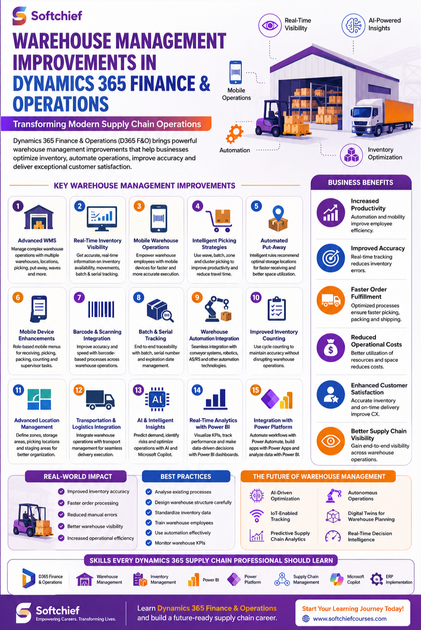
Key Warehouse Management Improvements in Dynamics 365 Finance & Operations
1. Advanced Warehouse Management System (WMS)
One of the biggest improvements in Dynamics 365 Finance & Operations is its advanced Warehouse Management System.
It supports complex warehouse operations including:
- Multiple warehouses
- Multiple locations
- Directed picking
- Put-away strategies
- Inventory movement
- Cycle counting
- Wave processing
Organizations can manage simple warehouses as well as complex distribution centres.
2. Real-Time Inventory Visibility
Accurate inventory information is essential for effective supply chain management.
Dynamics 365 Finance & Operations provides real-time visibility into:
- Available inventory
- Reserved inventory
- Incoming stock
- Warehouse locations
- Batch numbers
- Serial numbers
- Inventory movements
Employees and managers can make faster decisions because they always have access to accurate inventory information.
3. Mobile Warehouse Operations
Modern warehouses require mobility.
Dynamics 365 Finance & Operations provides mobile warehouse capabilities that allow workers to perform operations using handheld devices.
Warehouse employees can complete tasks such as:
- Receiving goods
- Product registration
- Picking items
- Packing orders
- Moving inventory
- Performing cycle counts
Benefits include:
- Reduced paperwork
- Faster processing
- Improved accuracy
- Real-time updates
4. Intelligent Warehouse Picking Strategies
Picking efficiency directly impacts delivery performance.
Dynamics 365 Finance & Operations supports advanced picking methods such as:
Wave Picking
Multiple orders are grouped together for efficient processing.
Batch Picking
Similar items are picked together for multiple orders.
Zone Picking
Workers are assigned to specific warehouse areas.
Cluster Picking
Employees pick multiple orders simultaneously.
These strategies reduce travel time and improve warehouse productivity.
5. Automated Put-Away Processes
Put-away determines where received inventory should be stored.
Dynamics 365 Finance & Operations uses intelligent rules to recommend storage locations based on:
- Product characteristics
- Warehouse layout
- Storage capacity
- Inventory policies
Benefits:
- Faster receiving
- Better space utilization
- Reduced manual decisions
6. Warehouse Mobile Device Enhancements
Warehouse workers can use configurable mobile menus designed specifically for their roles.
Examples:
Receiving employee:
- Receive purchase orders
- Register products
- Print labels
Picker:
- View picking tasks
- Confirm quantities
- Complete picking operations
Supervisor:
- Monitor warehouse activities
- Manage workload
This improves usability and operational efficiency.
7. Barcode and Scanning Integration
Barcode technology plays a major role in warehouse accuracy.
Dynamics 365 Finance & Operations supports barcode-based processes including:
- Product identification
- Inventory receiving
- Picking confirmation
- Shipment processing
- Cycle counting
Benefits:
- Reduced data entry errors
- Faster operations
- Improved traceability
8. Batch and Serial Number Tracking
Industries such as pharmaceuticals, manufacturing and food distribution require complete product traceability.
Dynamics 365 Finance & Operations supports:
- Batch tracking
- Serial number tracking
- Expiration management
- Quality control processes
Organizations can quickly identify:
- Product history
- Inventory location
- Customer shipments
This improves compliance and operational control.
9. Warehouse Automation Integration
Modern warehouses increasingly use automation technologies.
Dynamics 365 Finance & Operations integrates with:
- Conveyor systems
- Automated storage and retrieval systems (AS/RS)
- Robotics
- Warehouse automation solutions
- Transportation systems
Automation improves:
- Speed
- Accuracy
- Scalability
10. Improved Inventory Counting
Traditional physical inventory counting can disrupt operations.
Dynamics 365 Finance & Operations supports:
Cycle Counting
Employees count selected inventory regularly instead of shutting down operations.
Benefits:
- Continuous accuracy
- Reduced disruption
- Better inventory control
11. Advanced Location Management
Warehouse location management helps organizations optimize storage.
Businesses can define:
- Warehouse zones
- Storage areas
- Picking locations
- Bulk storage areas
- Staging locations
The system determines the most efficient inventory placement.
12. Transportation and Logistics Integration
Warehouse operations are closely connected with transportation.
Dynamics 365 Finance & Operations integrates warehouse activities with:
- Transportation management
- Shipment planning
- Carrier management
- Delivery scheduling
This creates a connected supply chain from warehouse to customer.
13. AI and Intelligent Supply Chain Insights
Microsoft continues adding AI capabilities across Dynamics 365 applications.
AI can help organizations:
- Predict inventory demand
- Identify supply chain risks
- Optimize warehouse operations
- Improve planning decisions
With Microsoft Copilot capabilities, users can interact with business data using natural language.
Examples:
“Which products are causing warehouse delays?”
“Which locations have excess inventory?”
“What are the fastest-moving products this month?”
AI-powered insights help managers make proactive decisions.
14. Real-Time Analytics with Power BI
Data-driven warehouse management requires powerful analytics.
Dynamics 365 Finance & Operations integrates with Power BI to provide dashboards for:
- Inventory performance
- Warehouse productivity
- Order fulfillment
- Picking efficiency
- Shipping performance
- Labour utilization
Managers can identify improvement opportunities and optimize operations continuously.
15. Integration with Microsoft Power Platform
Dynamics 365 Finance & Operations works seamlessly with Microsoft Power Platform.
Power Automate
Automate:
- Warehouse approval processes
- Notifications
- Inventory alerts
- Task assignments
Power Apps
Build custom applications for:
- Warehouse inspections
- Inventory audits
- Equipment tracking
Power BI
Create advanced supply chain dashboards.
Business Benefits of Dynamics 365 Finance & Operations Warehouse Management
Increased Warehouse Productivity
Automation reduces manual effort and improves employee efficiency.
Improved Inventory Accuracy
Real-time tracking reduces inventory discrepancies.
Faster Order Fulfillment
Optimized picking and packing processes improve delivery speed.
Reduced Operational Costs
Better resource utilization reduces unnecessary expenses.
Enhanced Customer Satisfaction
Accurate inventory and faster shipping improve customer experience.
Better Supply Chain Visibility
Managers gain complete visibility into warehouse performance.
Real-World Scenario: Warehouse Transformation Using Dynamics 365 Finance & Operations
A global manufacturing company managed multiple warehouses using manual processes.
Challenges:
- Inventory inaccuracies
- Slow picking operations
- Limited reporting
- High operational costs
After implementing Dynamics 365 Finance & Operations Warehouse Management:
Implemented:
- Mobile warehouse devices
- Barcode scanning
- Automated picking processes
- Real-time inventory tracking
- Power BI dashboards
- Advanced warehouse workflows
Results:
- Improved inventory accuracy
- Faster order processing
- Reduced manual errors
- Better warehouse visibility
- Increased operational efficiency
Best Practices for Implementing Warehouse Management in Dynamics 365 Finance & Operations
1. Analyse Existing Warehouse Processes
Before implementation, understand:
- Current workflows
- Warehouse layout
- Employee responsibilities
- Operational challenges
2. Design Warehouse Structure Carefully
Define:
- Warehouses
- Locations
- Zones
- Storage rules
A good warehouse structure improves system performance.
3. Standardize Inventory Data
Maintain accurate:
- Product information
- Units of measure
- Inventory policies
- Tracking settings
4. Train Warehouse Employees
Technology adoption depends on user understanding.
Provide:
- Training sessions
- Documentation
- Hands-on practice
5. Use Automation Where Possible
Identify processes that can be automated:
- Receiving
- Picking
- Notifications
- Reporting
6. Monitor Warehouse KPIs
Track:
- Order fulfillment rate
- Picking accuracy
- Inventory turnover
- Warehouse productivity
- Shipping performance
Common Mistakes to Avoid
Organizations should avoid:
- Implementing without process analysis
- Poor warehouse location setup
- Ignoring user training
- Not maintaining inventory data quality
- Over-customizing standard functionality
- Lack of integration planning
- Ignoring performance monitoring
Future of Warehouse Management with Dynamics 365 Finance & Operations
The future of warehouse management is becoming increasingly intelligent and automated.
Key trends include:
- AI-driven warehouse optimization
- Autonomous warehouse operations
- Robotics integration
- IoT-enabled inventory tracking
- Predictive supply chain analytics
- Digital twins for warehouse planning
- Real-time decision intelligence
Dynamics 365 Finance & Operations will continue evolving as a powerful platform for intelligent supply chain transformation.
Skills Every Dynamics 365 Supply Chain Professional Should Learn
Professionals working with Dynamics 365 Finance & Operations Warehouse Management should understand:
- Dynamics 365 Finance & Operations
- Supply Chain Management
- Warehouse Management System
- Inventory Management
- Procurement
- Transportation Management
- Product Information Management
- Power BI
- Power Platform
- Microsoft Copilot
- Data Management Framework
- Integration Services
- ERP Implementation
- Business Process Analysis
Conclusion
Warehouse management has become a strategic capability for modern businesses. Organizations need more than basic inventory tracking—they need intelligent systems that improve efficiency, accuracy and scalability.
Microsoft Dynamics 365 Finance & Operations provides a powerful Warehouse Management solution that helps businesses optimize receiving, storage, picking, packing and shipping operations.
Through automation, mobile capabilities, real-time visibility, advanced tracking and AI-powered insights, organizations can transform traditional warehouses into intelligent supply chain operations.
For companies looking to improve operational efficiency and compete in a digital economy, investing in Dynamics 365 Finance & Operations Warehouse Management is not just a technology upgrade—it is a foundation for long-term supply chain success.