How to Become a Dynamics 365 CE Functional Consultant in 2026: Build Skills, Projects and a Career Path

Introduction
A Dynamics 365 CE functional consultant turns messy business processes into useful customer solutions. In 2026, companies need people who can connect sales, service, marketing, operations, users and technical delivery teams.
The role includes discovery, process improvement, configuration, testing, training, documentation and adoption tracking. Dynamics 365 CE covers customer engagement apps such as Sales, Customer Service and Field Service, alongside Dataverse, Power Automate, Power BI, Power Apps and Microsoft 365. The strongest career path combines product knowledge with business analysis and clear communication.
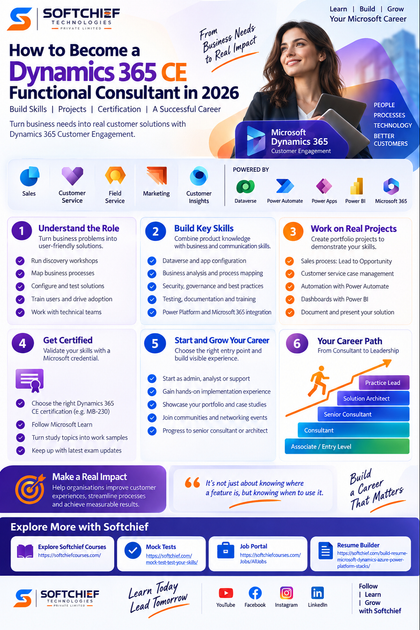
Turn Dynamics 365 CE Knowledge Into Business Value
Understand the functional consultant’s daily work
A consultant begins with stakeholder interviews and discovery workshops. They map the current process, identify pain points and agree on the desired result before changing the system. They then write requirements, configure the app, support testing, train users and help teams after launch.
Project size changes the role. A small employer may expect one person to manage configuration, support and reporting. A large partner may split work among business analysts, consultants, developers, testers and project managers.
Connect apps to customer journeys
Dynamics 365 Sales supports lead qualification, account management, activities, opportunities and revenue processes. Customer Service supports cases, queues, knowledge articles, service-level agreements, feedback and omnichannel work. Field Service adds work orders, scheduling and mobile technician tools, while Customer Insights can support marketing and customer data scenarios.
A consultant doesn’t need to master every app on day one. Start with one business area, then learn how related apps share data through Dataverse.
Know the difference between related roles
| Role | Main responsibility | Common deliverables | Technical depth | Progression |
|---|---|---|---|---|
| Functional consultant | Business requirements and app design | Process maps, configuration, tests | Medium | Senior consultant |
| Power Platform consultant | Apps, flows and Dataverse solutions | Canvas apps, flows, governance plans | Medium-high | Solution architect |
| Administrator | Users, settings and support | Security changes, reports, support records | Medium | Application lead |
| Developer | Code and complex extensions | Plugins, JavaScript, integrations | High | Senior developer |
| Solution architect | End-to-end technical design | Architecture and integration plans | High | Practice lead |
| Project manager | Scope, budget, risks and delivery | Plans, status reports, decisions | Low-medium | Program manager |
Consultants configure no-code and low-code features where possible. They work with developers when a requirement needs custom code, complex integration or specialist performance work.
Build the Skills Employers Expect From a Dynamics 365 CE Functional Consultant
Learn Dataverse and Dynamics 365 foundations
Study environments, solutions, tables, columns, relationships, forms, views, business rules, business process flows and security roles. Add teams, ownership, auditing, data import and reporting to your practice work. Dataverse provides the shared data platform behind many Dynamics 365 and Power Platform solutions.
Create a personal glossary. Define each term in plain language, then build it in a Microsoft learning environment or approved trial instance. Employers value clear explanations more than memorized menu paths.
Improve analysis, communication and testing
Learn to run interviews, write user stories, define acceptance criteria, map processes and complete fit-gap reviews. A useful discovery framework asks: What happens now? Where do delays occur? Who owns each step? What compliance rules apply? Which systems must connect? What reports do leaders need? How will success be measured?
Good consultants explain design choices to nontechnical users. They also write test scenarios, support user acceptance testing, triage defects and prepare training guides. Microsoft implementation guidance places strong focus on adoption, user enablement and continued measurement after launch.
Prove Your Capability With Portfolio-Ready Projects
Build a sales process from lead to opportunity
Create a practice solution for a fictional company. Configure lead qualification, accounts, contacts, opportunities, activities, stages, views, dashboards and security roles. Add a business process flow and document the business problem, user stories, requirements and test plan.
Your portfolio should show process maps, configuration decisions, test results and lessons learned. Label the work as a portfolio project, not client implementation experience.
Design a customer service case solution
Build case creation, queues, priority rules, routing, escalation, knowledge articles and resolution steps. Add entitlements or service-level agreements, then design separate views for agents and supervisors. Explain how the design can improve response consistency and case visibility.
Include a before-and-after process map, acceptance criteria, agent guide and dashboard specification. A short recorded walkthrough can show how a case moves from creation to closure.
Add automation, reporting and governance
Use Power Automate for approvals, notifications or data-quality checks. Use Power BI for service trends and management views. Power Apps or Copilot features may fit selected scenarios, but each addition needs a clear business reason.
Review security, licensing, performance, maintenance and support impact before adding automation. Your portfolio checklist should include requirements, process maps, screenshots, solution components, security design, test scripts, user documentation and a recorded demo.
Use Certifications and Practice to Become Job-Ready
Choose a current Microsoft credential
Certifications support structured learning, but they don’t replace delivery evidence. Start with the Microsoft Learn credentials catalog and confirm the active Dynamics 365 Customer Service or Customer Experience credential before booking an exam.
The official MB-230 exam outline currently covers cases, knowledge management, queues, service-level agreements, routing and customer feedback. Be careful with old sales study plans: Microsoft lists the MB-210 Sales exam as retired. Microsoft updates exam names, objectives and retirement dates, so check the live page in 2026.
Turn study topics into work samples
Study Dataverse, security, app configuration, process design, reporting, integration, testing and implementation methods through Microsoft Learn and scenario-based practice. Turn each topic into an artifact: a security matrix, requirements document, configured process, dashboard brief, test script or user guide.
Prepare to answer interview questions about conflicting requirements, configuration versus customization, data migration and failed automation. Explain the trade-off, the risk and the business result.
Move From Your First Role to Long-Term Career Growth
Choose an entry point that fits your background
CRM administrator, application support analyst, business analyst, implementation coordinator, sales operations and customer service operations roles can lead to Dynamics 365 consulting. Power Platform roles offer another route through Dataverse, apps, automation and governance.
Rewrite your résumé around outcomes. Show process improvements, requirements work, testing, training and stakeholder decisions instead of listing features alone. Consulting partners, internal business application teams, contract work, volunteer projects and professional communities can provide useful exposure.
Build experience through visible evidence
Study published Microsoft customer stories to see how organizations connect customer service, sales data, automation and reporting to a business need. Use the same structure in your own case studies: name the fictional organization, state the problem, show the solution scope, explain the decisions and describe the expected measure.
Your project history should show more than screenshots. It should prove that you can ask useful questions, protect data, test changes and explain user impact.
Plan the next two to five years
| Career stage | Skills and evidence |
|---|---|
| Year 1 | Dataverse, one CE app, testing, support work and a portfolio |
| Years 2-3 | Full workstreams, workshops, migration planning and a current certification |
| Years 3-5 | Estimation, governance, integrations, mentoring and executive presentations |
| Beyond 5 years | Solution architecture, practice leadership, commercial planning or independent advisory work |
Compensation depends on location, industry, employment model, specialization and experience. Compare dated salary surveys or local job data, and separate base pay, contract rates, bonuses and benefits. Avoid treating one market’s figures as a global standard.
Conclusion
Becoming a Dynamics 365 CE functional consultant in 2026 requires more than product knowledge. Build skills in Dataverse, application configuration, business analysis, communication, testing, change management and user adoption.
Choose one sales or service scenario. Write the requirements, map the process, configure a working solution and test it with realistic users. Publish the result as a clearly labeled portfolio case study, then pursue the current Microsoft credential and target roles that add real implementation experience.
The strongest candidates can explain why a solution fits the business, how it supports measurable results and how users will adopt it. They know where a feature is located, but they also know when to use it.