Power Apps vs Traditional App Development: Is Low-Code Winning in 2026?
Introduction
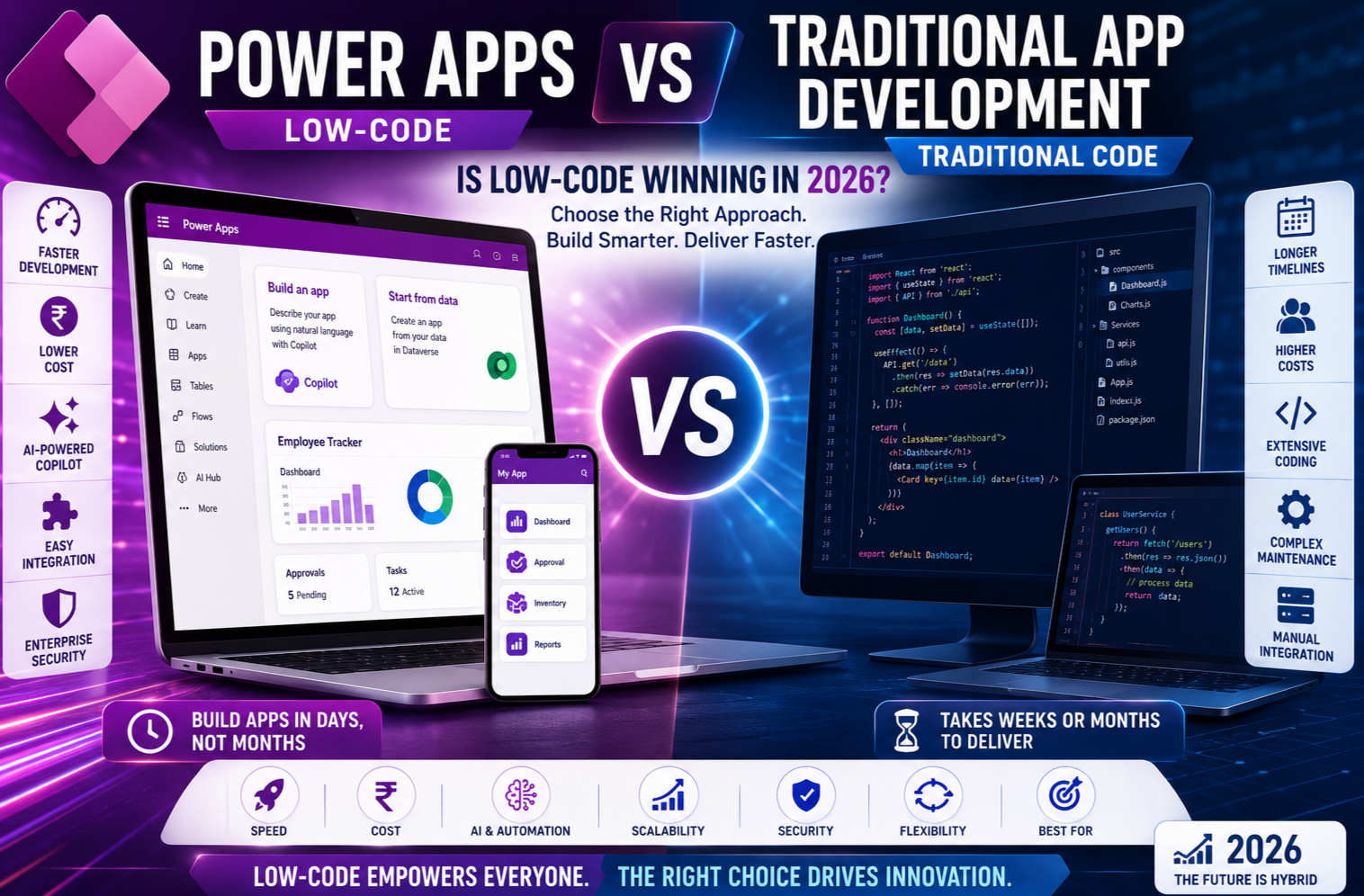
For decades, businesses relied on traditional software development to build custom applications. Every feature required months of coding, testing and deployment by experienced software developers. While this approach offered maximum flexibility, it often came with high costs, long development cycles and ongoing maintenance challenges.
Fast forward to 2026, and the landscape has changed dramatically. Microsoft Power Apps has become one of the world’s leading low-code platforms, enabling organisations to create powerful business applications in days instead of months. With AI-powered development, seamless Microsoft ecosystem integration and enterprise-grade security, Power Apps is transforming how businesses approach application development.
But does this mean traditional app development is becoming obsolete? Or does it still have an important role to play?
In this comprehensive guide, we’ll compare Power Apps and traditional app development to help you determine which approach is best for your organisation.
What Is Microsoft Power Apps?
Microsoft Power Apps is a low-code application development platform within the Microsoft Power Platform. It enables users to build custom web and mobile applications using visual tools, drag-and-drop components and AI-assisted development.
Unlike traditional programming, Power Apps reduces the need for writing extensive code, allowing both professional developers and business users to create applications quickly.
Power Apps integrates seamlessly with:
- Microsoft 365
- Microsoft Teams
- SharePoint
- Dataverse
- Dynamics 365
- Azure
- SQL Server
- Salesforce
- SAP
- Hundreds of third-party services
In 2026, AI-powered Copilot and intelligent Agents have made application development even faster by generating screens, workflows, business logic and formulas using natural language prompts.
What Is Traditional App Development?
Traditional application development involves writing software using programming languages such as:
- C#
- Java
- Python
- JavaScript
- TypeScript
- PHP
- Kotlin
- Swift
Developers design system architecture, create databases, write backend APIs, develop user interfaces, test applications and deploy them using professional development frameworks.
Popular frameworks include:
- .NET
- React
- Angular
- Vue.js
- Spring Boot
- Django
- Node.js
Traditional development provides complete flexibility but typically requires specialised technical expertise.
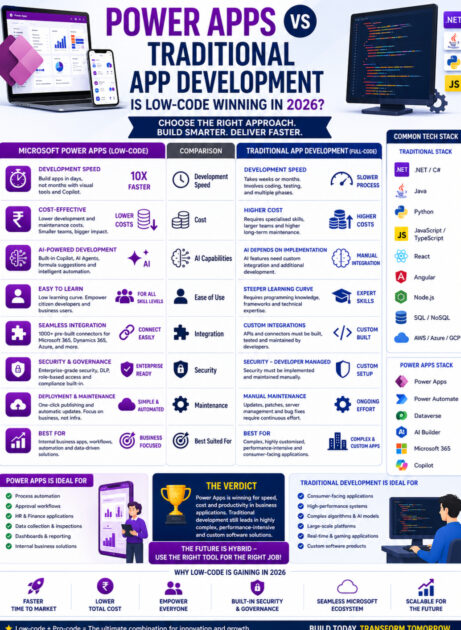
Power Apps vs Traditional Development: Feature Comparison
| Feature | Power Apps | Traditional Development |
|---|---|---|
| Development Speed | Days | Weeks or Months |
| Coding Required | Minimal | Extensive |
| AI Assistance | Built-in Copilot & AI Agents | Depends on implementation |
| Cost | Lower | Higher |
| Maintenance | Simplified | Developer-managed |
| Deployment | One-click publishing | Manual CI/CD pipelines |
| Integration | Hundreds of connectors | Custom API development |
| Scalability | Enterprise-ready | Unlimited with architecture |
| Learning Curve | Easy | Steep |
| Best For | Business Applications | Complex Custom Software |
1. Development Speed
One of the biggest advantages of Power Apps is speed.
A customer service portal that may take several months using traditional development can often be built in just a few days using Power Apps.
Traditional Development Process
- Requirements gathering
- UI design
- Backend development
- API creation
- Database design
- Frontend development
- Testing
- Deployment
Power Apps Process
- Connect to data
- Describe the app using Copilot
- Customise screens
- Add workflows
- Publish
This rapid development enables organisations to respond quickly to changing business needs.
2. Cost Comparison
Traditional software projects often involve:
- Software architects
- Backend developers
- Frontend developers
- UI/UX designers
- QA engineers
- DevOps engineers
- Project managers
Power Apps significantly reduces development costs by allowing a smaller team—or even skilled business users—to build and maintain applications.
Example
A simple employee leave management application:
Traditional Development
- Development time: 3–5 months
- Team size: 5–8 people
- Estimated cost: ₹10–20 lakhs
Power Apps
- Development time: 2–4 weeks
- Team size: 1–2 people
- Estimated cost: ₹1–3 lakhs
3. AI-Powered Development
In 2026, AI is the biggest differentiator.
Power Apps includes:
- Copilot-assisted app creation
- AI Agents
- Formula generation
- Workflow recommendations
- Automated UI generation
- Intelligent data modelling
Traditional development can also use AI, but developers must integrate AI services manually, adding time and complexity.
4. Ease of Learning
Learning traditional software development often requires mastering:
- Programming languages
- Databases
- APIs
- Frameworks
- Cloud services
- Version control
- Design patterns
Power Apps focuses on visual development, making it accessible to:
- Business Analysts
- Functional Consultants
- Project Managers
- Citizen Developers
- Students
- IT Administrators
This broader accessibility empowers more people to contribute to digital transformation.
5. Integration with Business Systems
Power Apps excels at connecting with existing business platforms.
It offers hundreds of pre-built connectors for services such as:
- Microsoft 365
- Dynamics 365
- Azure SQL
- SharePoint
- Outlook
- Teams
- SAP
- Oracle
- Salesforce
- ServiceNow
Traditional development often requires custom APIs, authentication and ongoing maintenance for each integration.
6. Scalability
This is an area where the answer depends on the application.
Power Apps
Ideal for:
- Internal business applications
- Workflow automation
- Approval systems
- CRM extensions
- HR applications
- Inventory tracking
- Inspection apps
- Field service tools
Traditional Development
Better suited for:
- Social media platforms
- Gaming applications
- Streaming services
- Banking platforms
- E-commerce marketplaces
- Large-scale consumer applications
While Power Apps is enterprise-ready, highly specialised consumer-facing platforms often require traditional development.
7. Security and Governance
Security is a priority for every organisation.
Power Apps provides:
- Microsoft Entra ID authentication
- Role-based security
- Data Loss Prevention (DLP) policies
- Environment management
- Compliance tools
- Audit logs
- Enterprise governance
Traditional applications require developers to implement and maintain these security features manually.
8. Maintenance and Updates
Traditional applications often require:
- Bug fixes
- Framework upgrades
- Server patches
- Database optimisation
- Security updates
Power Apps handles much of the underlying platform maintenance automatically, allowing organisations to focus on improving business processes rather than managing infrastructure.
9. Real-World Business Example
Consider a logistics company that needs a delivery inspection application.
Traditional Development
The project may involve:
- Requirements gathering
- UI design
- Android development
- iOS development
- Backend APIs
- Testing
- Deployment
Timeline: 5–6 months
Power Apps
The company can:
- Connect to Dataverse
- Build responsive forms
- Capture images
- Scan barcodes
- Collect digital signatures
- Work offline
- Sync automatically
Timeline: 2–3 weeks
This enables businesses to achieve faster returns on investment.
10. Where Traditional Development Still Wins
Despite the advantages of low-code, traditional development remains essential in scenarios requiring:
- Highly customised user experiences
- Advanced algorithms
- Real-time gaming
- High-frequency financial trading
- Large-scale consumer platforms
- Complex graphics rendering
- Operating system-level applications
These projects demand the flexibility and performance that full-code development provides.
Is Low-Code Really Winning in 2026?
The answer is yes—but with context.
Low-code platforms like Power Apps are becoming the preferred choice for internal business applications because they offer:
- Faster delivery
- Lower costs
- AI-assisted development
- Easier maintenance
- Strong Microsoft integration
- Enterprise security
However, traditional development continues to dominate in areas where complete control, custom architecture and high-performance computing are required.
Rather than replacing traditional development, low-code is complementing it by allowing organisations to build routine business solutions more efficiently.
Who Should Choose Power Apps?
Power Apps is ideal for:
- Businesses using Microsoft 365
- Dynamics 365 customers
- HR departments
- Finance teams
- Manufacturing companies
- Healthcare organisations
- Educational institutions
- Government agencies
- Start-ups seeking rapid development
- Organisations pursuing digital transformation
When Should You Choose Traditional Development?
Traditional development is the better option when you need:
- Consumer-facing applications with millions of users
- Custom software products for sale
- High-performance applications
- Complex AI models
- Advanced data processing
- Custom operating system integrations
- Full architectural control
Future Trends in 2026 and Beyond
The future of application development is increasingly hybrid. Organisations are combining the strengths of low-code and traditional coding to achieve the best outcomes.
Key trends include:
- AI-assisted software development
- Multi-agent business automation
- Citizen developer adoption
- Fusion development teams
- Hyperautomation
- Cloud-native business applications
- Intelligent workflow orchestration
Power Apps is expected to play an even greater role as AI capabilities continue to evolve.
Final Verdict
Power Apps is undeniably transforming how businesses build applications. With AI-powered Copilot, intelligent automation, rapid development and seamless Microsoft integration, it has become the platform of choice for many internal business solutions.
However, traditional app development remains indispensable for building highly customised, large-scale and performance-intensive software.
The smartest organisations in 2026 are not choosing one over the other—they are leveraging both. They use Power Apps to accelerate business application development while relying on traditional development for specialised products and complex software ecosystems.
The future isn’t Power Apps versus traditional development—it’s about using the right tool for the right job.
Conclusion
In 2026, low-code is no longer an emerging trend—it is a strategic advantage. Microsoft Power Apps empowers organisations to innovate faster, reduce development costs and bring AI-driven business solutions to life with unprecedented speed.
While traditional development continues to play a critical role in building complex software systems, Power Apps has firmly established itself as the preferred platform for modern business application development.
If your goal is to accelerate digital transformation, improve productivity and build secure, scalable business applications, now is the ideal time to invest in Microsoft Power Apps.