Turning Project Work into Technical Evidence: Build a Portfolio That Proves Your Skills

Introduction
A skills list can say you know Python, CAD, data analysis, or cloud tools. It can’t show how you used them when a deadline, budget, or technical limit got in the way. Turning project work into technical evidence gives people a clearer view of how you solve problems, make choices, and check your results.
The strongest project stories connect a specific claim to something a reader can inspect. They explain the goal, your role, the decisions you made, and what happened after the work was done.
You can build that story from a work project, a class assignment, a volunteer task, or a personal build. Choose a useful example, gather a few clear artifacts, explain your reasoning, and share only what you have permission to show.
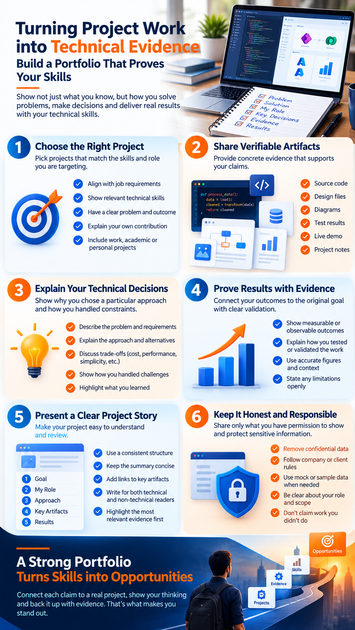
Choose project work that proves relevant technical skills
A portfolio works best when each project helps answer a real question: can you do the work this role, client, or audience needs? You don’t need to show every task you’ve completed. A few well-chosen examples can make your skills easier to assess.
Match project evidence to the skill or role
Start with the technical skills your audience needs. For a data role, a project might show how you cleaned a dataset, wrote a query, or checked an analysis. For a design role, a prototype can show how you turned a user need into a working flow.
Pick work that demonstrates the skill directly. A long list of unrelated projects can make it harder to see what you do well. If a project shows several skills, name the specific parts that support each claim.
Prioritize projects with clear problems and decisions
Choose work with a clear goal, a real constraint, and a result you can explain. For example, a small script that removes a repeated manual task may be easier to assess than a large app with unclear goals and no record of your role. The point is to show how you approached the work, not to make the project sound grand.
A useful project story explains what made the task hard. Maybe the data had gaps, the device had limited memory, or the design had to work on mobile screens. Those details help readers understand why you made certain choices.
Define your contribution to collaborative work
Team projects can provide strong evidence when you explain your part with care. State what you owned, such as building an API route, writing test cases, or preparing a user study. Name shared decisions as team decisions rather than presenting them as your work alone.
Credit collaborators where it makes sense, and don’t claim ownership of work you didn’t do. If you can’t share the full project, describe your contribution at a high level and include only approved materials.
Turn project work into technical evidence with verifiable artifacts
An artifact gives readers something concrete to review. It could be source code, a design file, a system diagram, test output, project notes, or a working demo. Choose items that back up your claims; a large folder of files can bury the useful details.
Select artifacts that show the work in action
Pick artifacts that fit the project and the skill you want to show. Code can support a claim about implementation, while a test report can show how you checked a feature. A diagram may help explain how data moves through a system.
Use a small, focused set. For a web tool, that might mean a live demo, a key code file, and a few test results. Each item should have a clear purpose in the project story.
Add context so each artifact makes sense
A screenshot or file rarely explains itself. Add a short note that says what the reader is seeing, why it matters, and how it supports the project goal. For example, explain what a test checks and which part of the system it covers.
Link to the relevant file or section when possible. GitHub’s README guidance recommends using project documentation to explain what a project does, why it is useful, and how people can get started. A clear README can give reviewers those basics before they inspect the code.
Make evidence accessible and trustworthy
Test every link and demo before you share your portfolio. Give simple setup steps if a project needs special software, sample data, or environment settings. If a demo depends on an account or device, explain that up front.
For code or data, provide enough context for someone to interpret what they see. A chart without labels or a code sample without its inputs may leave readers guessing. Remove private keys, personal data, and other restricted details before publishing.
Explain technical decisions behind your project work
A finished product shows what you built. A clear account of your reasoning shows how you handled the work. Focus on the choices that shaped the result, rather than describing every step in order.
Describe the problem, constraints, and requirements
Start with the problem in plain language. Say who needed the work, what they needed to do, and what counted as success. Then name the limits that shaped the solution, such as time, cost, device support, or data quality.
Keep the description specific. “I improved the dashboard” is hard to assess. “I changed the filter flow so staff could find a record by date or status” gives the reader a clearer picture of the task.
Show why you chose one approach over another
Explain the main technical choice and why it fit the project. You might describe why you used a local database instead of a cloud service, or why you chose a simpler interface over a feature-heavy one. Mention trade-offs that mattered, such as speed, ease of upkeep, cost, or compatibility.
Keep the explanation tied to what happened. Don’t invent alternatives you never considered or claim that your approach was best in every case. A sound decision fits the project’s needs and limits.
Make troubleshooting and revision visible
A useful project story can include a bug, a failed test, or a design change. Describe what went wrong, what you checked, and what you changed. For instance, if a page loaded slowly on older phones, explain how you found the cause and what you adjusted.
Include only revisions that help show your judgment or learning. A list of every minor change adds little. One clear example can show how evidence from testing or debugging shaped the next version.
Prove the result with credible validation
A strong result is tied to the original goal and backed by a clear check. Explain how you know the work met its purpose. If you don’t have a measured result, say what you observed without turning it into a number.
Connect outcomes to the project’s original goal
State what changed after the work and how you observed that change. If the project aimed to reduce manual steps, describe which steps were removed or combined. If the goal was clearer navigation, explain what changed in the user flow.
Separate measured results from personal assessment or feedback. A timed test, a set of passing checks, and a comment from a user are different kinds of evidence. Label them accurately so readers can judge what each one shows.
Show how you tested or reviewed the work
Name the checks you actually used. These might include automated tests, peer review, a usability session, a benchmark, or agreed acceptance criteria. Explain what the check covered and who took part when that detail matters.
Don’t imply that a small test proves more than it does. A demo that worked on one device confirms that case, not every possible device. Clear limits make your account more credible.
Use precise claims and disclose limits
Avoid unsupported claims such as “cut costs by 50%” unless you have records that support the figure. Use exact wording for what you measured, when you measured it, and under what conditions. If you only have informal feedback, say so.
If the work is incomplete, state what remains untested or what you would change next. That detail helps readers see the scope of your work without weakening the parts you can prove.
Present technical evidence as a clear, responsible portfolio
A portfolio should help a reader find the strongest evidence quickly. Use the same basic structure for each project, then adjust the detail to fit the work. A consistent format makes it easier to compare projects without forcing them into identical stories.
Structure each project story for quick review
Lead with the goal and your role. Then explain the main constraint, approach, key artifacts, validation, and outcome. Put the strongest evidence near the top, and keep background details brief.
A project page or repository README can hold the summary, links, and setup notes. Readers who want more can follow links to deeper documentation, code, or design files. This keeps the main story easy to scan.
Tailor the detail to your audience
Technical readers may want to inspect code, test design, or system choices. Non-specialists need to understand the problem and why the result mattered. Use clear headings and short explanations so each group can find what it needs.
Explain technical terms when they affect the project story. You don’t need to remove all technical detail; give readers a plain-language path into it. A link to deeper notes can hold extra detail without crowding the summary.
Protect confidential information and respect ownership
Before sharing project files, check who owns them and whether you have permission to publish. Remove private data, company details, credentials, and client materials that you’re not allowed to disclose. Ask for approval when the rules are unclear.
You can use a mock dataset or a recreated example if that keeps sensitive details private. Be clear about what you changed, and don’t present a recreated sample as the original work. Protecting privacy matters, but the description must still reflect your actual contribution.
Conclusion: Make every technical claim traceable to evidence
A strong technical portfolio connects a clear claim to a project, a visible artifact, and a credible account of the result. Choose work that fits your audience, explain your personal contribution, and show the decisions behind the finished product. Then test the links, describe the checks you performed, and share only what you’re allowed to share.
Start with one project you already have. Add a direct problem statement, link one or more useful artifacts, and explain how you checked the result. That small update can turn a vague skills claim into evidence someone can review.