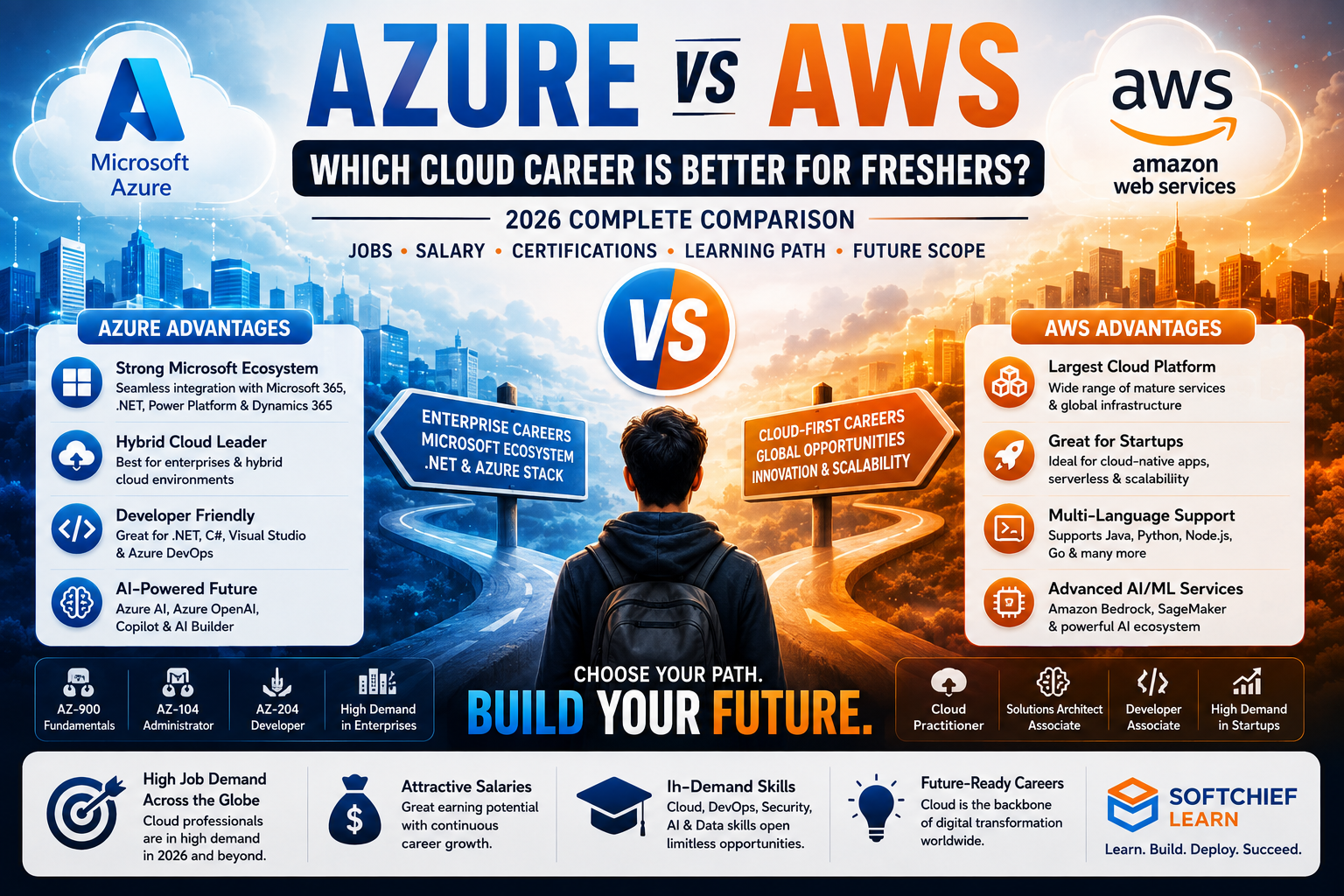
Azure vs AWS: Which Cloud Career Is Better for Freshers? (2026 Complete Comparison)
Introduction
Cloud computing has become one of the most sought-after skills in the IT industry. Organizations of every size—from startups to global enterprises—are moving applications, databases, analytics platforms, and AI workloads to the cloud.
For students and fresh graduates, this creates an important question:
Should I learn Microsoft Azure or Amazon Web Services (AWS)?
Both Azure and AWS are industry-leading cloud platforms with excellent career opportunities. However, they differ in ecosystem, enterprise adoption, learning paths, and the types of roles they commonly support.
If you’re a B.Tech graduate, MCA student, software developer, career switcher, or aspiring cloud engineer, this guide will help you understand the differences and make an informed decision.
Why Cloud Computing Is a Great Career Choice in 2026
Organizations increasingly rely on cloud platforms to:
- Host web applications
- Build APIs and microservices
- Run AI and machine learning workloads
- Store and analyze large datasets
- Improve scalability and security
- Reduce infrastructure costs
- Support remote and hybrid work environments
As cloud adoption grows, demand for skilled professionals continues to expand across development, infrastructure, DevOps, security, and data engineering.
What Is Microsoft Azure?
Microsoft Azure is Microsoft’s cloud computing platform that provides services for:
- Virtual Machines
- Web Applications
- Databases
- Networking
- Storage
- Artificial Intelligence
- DevOps
- Kubernetes
- Serverless Computing
- Data Analytics
Azure integrates closely with the Microsoft ecosystem, making it a popular choice for organizations already using Microsoft products and services.
What Is AWS?
Amazon Web Services (AWS) is Amazon’s cloud platform offering a wide range of cloud services.
It provides solutions for:
- Compute
- Storage
- Databases
- Machine Learning
- Networking
- Analytics
- Security
- Serverless Computing
- Containers
- DevOps
AWS has a long history in the cloud market and supports organizations across many industries.
Azure vs AWS: Quick Comparison
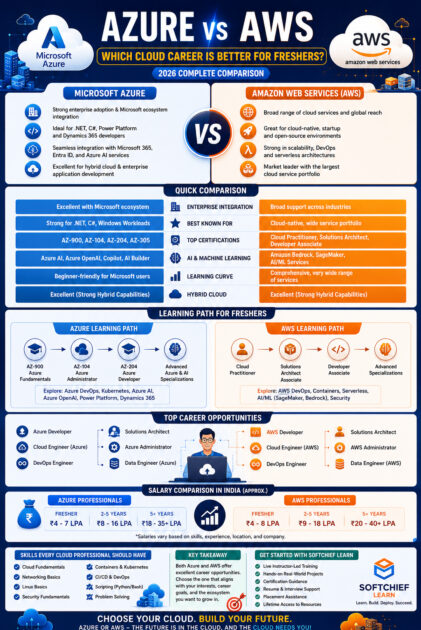
| Feature | Microsoft Azure | Amazon Web Services (AWS) |
|---|---|---|
| Cloud Type | Public, Hybrid, Multi-cloud | Public, Hybrid, Multi-cloud |
| Enterprise Integration | Excellent with Microsoft ecosystem | Broad support across many platforms |
| Best Known For | Enterprise, Microsoft workloads | Broad cloud service portfolio |
| Learning Curve | Beginner-friendly for Microsoft users | Comprehensive but can feel broader initially |
| Certifications | AZ-900, AZ-104, AZ-204 | Cloud Practitioner, Solutions Architect, Developer |
| AI Integration | Azure AI, Azure OpenAI, Copilot | Amazon Bedrock, SageMaker and AI services |
| Development Stack | .NET, C#, Power Platform, Dynamics 365 | Java, Python, Node.js, Go and others |
| Hybrid Cloud | Strong focus and mature capabilities | Strong support with hybrid offerings |
| Microsoft Integration | Native | Available through integrations |
Both platforms are excellent choices, and many cloud concepts transfer between them.
Market Demand
Both Azure and AWS are widely adopted across industries.
Azure
Commonly used in:
- Banking
- Healthcare
- Manufacturing
- Government
- Retail
- Enterprise consulting
- Microsoft partner organizations
Azure is especially prevalent in organizations that already rely on Microsoft technologies such as Microsoft 365, Dynamics 365, and Power Platform.
AWS
Commonly used in:
- Startups
- SaaS companies
- E-commerce
- Media
- Technology companies
- Cloud-native organizations
AWS has broad adoption across a wide variety of cloud-first environments.
Which Platform Is Easier for Freshers?
For many beginners, Azure can offer a smoother learning experience if they are already familiar with Windows, C#, .NET, SQL Server, or Microsoft technologies.
Azure learning often feels more intuitive because of its integration with:
- Visual Studio
- GitHub
- Microsoft 365
- Power Platform
- Active Directory (Microsoft Entra ID)
- Dynamics 365
AWS also has an excellent learning ecosystem but offers a very large number of services, which can feel overwhelming at first.
Regardless of the platform you choose, focus on understanding cloud fundamentals before diving into advanced services.
Learning Roadmap
Azure Roadmap
Step 1
Learn:
- Cloud Fundamentals
- Virtual Machines
- Storage
- Networking
Certification:
- AZ-900
Step 2
Study:
- Azure App Service
- Azure SQL
- Azure Functions
- Azure Storage
- Monitoring
Certification:
- AZ-204 (Developers) or AZ-104 (Administrators)
Step 3
Explore:
- Azure DevOps
- Kubernetes
- Azure AI
- Azure OpenAI
- Azure API Management
AWS Roadmap
Step 1
Learn:
- Core cloud concepts
- EC2
- S3
- IAM
- VPC
Certification:
- AWS Certified Cloud Practitioner
Step 2
Study:
- Lambda
- RDS
- Elastic Beanstalk
- CloudFormation
- Monitoring
Certification:
- AWS Certified Developer or Solutions Architect – Associate
Step 3
Explore:
- Containers
- DevOps
- AI services
- Security
- Analytics
Azure Certifications vs AWS Certifications
Azure
Beginner
- AZ-900 – Microsoft Azure Fundamentals
Intermediate
- AZ-104 – Azure Administrator Associate
- AZ-204 – Azure Developer Associate
Advanced
- Azure Solution Architect
- Azure DevOps Engineer
- AI-related certifications
AWS
Beginner
- AWS Certified Cloud Practitioner
Intermediate
- AWS Certified Developer – Associate
- AWS Certified Solutions Architect – Associate
- AWS Certified SysOps Administrator – Associate
Advanced
- AWS Certified Solutions Architect – Professional
- AWS DevOps Engineer – Professional
- AWS Security Specialty
Choose certifications that align with your intended role rather than collecting multiple credentials.
Development Opportunities
Azure
If you’re interested in:
- C#
- .NET
- Power Platform
- Dynamics 365
- Azure Functions
- Enterprise applications
Azure is a natural fit.
AWS
If you’re interested in:
- Cloud-native applications
- Serverless architectures
- Open-source ecosystems
- Broad language support
AWS offers many opportunities.
AI and the Future of Cloud
Artificial Intelligence is becoming a core part of cloud careers.
Azure
Microsoft provides:
- Azure AI Services
- Azure OpenAI Service
- Copilot integrations
- AI Builder
- Machine Learning services
These services integrate closely with the broader Microsoft ecosystem.
AWS
AWS offers AI and machine learning capabilities through services such as Amazon Bedrock, Amazon SageMaker, and other managed AI offerings.
No matter which cloud you choose, AI skills will increasingly complement traditional cloud expertise.
Azure vs AWS for Different Career Goals
If You Want to Become a .NET Developer
Choose Azure
It integrates naturally with:
- C#
- ASP.NET Core
- Visual Studio
- Azure DevOps
If You Want to Work with Power Platform
Choose Azure
Power Platform solutions often integrate with Azure services, making Azure knowledge highly valuable.
If You Want to Become a Dynamics 365 Developer
Choose Azure
Dynamics 365 implementations frequently use Azure Functions, Logic Apps, API Management, and other Azure services.
If You Want to Focus on General Cloud Engineering
Both Azure and AWS are excellent choices.
Build strong cloud fundamentals first, then specialize based on your interests or employer requirements.
Real-World Projects to Build
Azure Projects
- Employee Management System on Azure App Service
- Serverless REST API using Azure Functions
- File Upload Application with Azure Blob Storage
- AI-powered Chatbot using Azure OpenAI
- Inventory Management System with Azure SQL
AWS Projects
- Static website hosted on S3
- Serverless API using Lambda
- Cloud file storage solution
- Event-driven image processing
- Basic monitoring and logging solution
Projects demonstrate your practical skills and help reinforce cloud concepts.
Skills Employers Look For
Regardless of the cloud platform, employers value:
Technical Skills
- Networking fundamentals
- Linux basics
- Databases
- REST APIs
- Git
- CI/CD
- Containers
- Security fundamentals
Soft Skills
- Communication
- Problem-solving
- Documentation
- Team collaboration
- Continuous learning
These skills complement your cloud expertise.
Common Mistakes Freshers Make
Avoid these common pitfalls:
- Trying to learn Azure and AWS simultaneously.
- Memorizing services instead of understanding cloud concepts.
- Skipping hands-on labs.
- Ignoring networking and security basics.
- Building only tutorial-based projects.
- Chasing certifications without practical experience.
Master one platform first, then expand your knowledge later.
Which One Should You Choose?
Choose Azure If You:
- Want to become a C#/.NET Developer
- Plan to work with Power Platform
- Want a Dynamics 365 career
- Prefer enterprise software development
- Intend to use Microsoft AI services and Copilot technologies
Choose AWS If You:
- Want exposure to a broad cloud ecosystem
- Plan to work in cloud-native or startup environments
- Prefer open-source-heavy development stacks
- Are interested in AWS-specific enterprise environments
Ultimately, both platforms provide excellent career opportunities. Your choice should align with the technologies and industries you want to work with.
Why Learn Azure with Softchief Learn?
At Softchief Learn, our Azure programs are designed to prepare learners for real-world cloud development and enterprise application roles.
What You’ll Learn
- Live instructor-led classes
- Azure Fundamentals (AZ-900)
- Azure Developer (AZ-204)
- Azure App Service
- Azure Functions
- Azure SQL Database
- Azure Storage
- Azure DevOps
- Azure AI and Azure OpenAI
- Power Platform and Dynamics 365 integration
- Real-world cloud projects
- Resume building
- Mock interviews
- Placement assistance
- Lifetime access to recordings
- Community support
- Updated curriculum aligned with the latest Microsoft technologies
Our focus is on helping learners build practical cloud skills that employers value.
Conclusion
Azure and AWS are both outstanding cloud platforms, and there is no universally “better” choice. The right platform depends on your career goals, preferred technology stack, and the types of organizations you aspire to work with.
For learners who want to build careers around Microsoft technologies such as Power Platform, Dynamics 365, C#/.NET, Microsoft 365, and Azure AI, Azure offers a natural progression and deep ecosystem integration. Those aiming for broader cloud-native environments may find AWS aligns well with their objectives.
Whichever platform you choose, success will come from mastering cloud fundamentals, building real-world projects, earning relevant certifications, and continuously expanding your practical skills. Cloud computing is a long-term career journey, and consistent learning will help you stay ahead in an ever-evolving technology landscape.