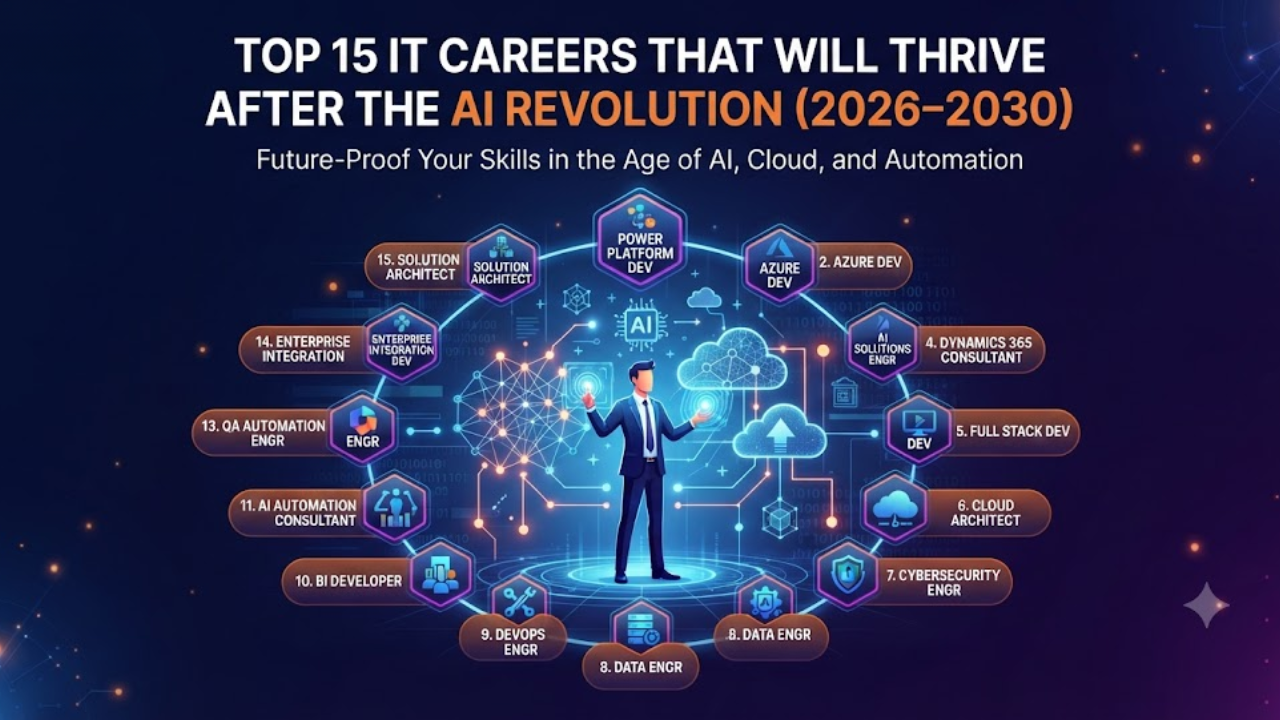
Top 15 IT Careers That Will Still Be in High Demand After the AI Revolution
Introduction
Artificial Intelligence is transforming the IT industry faster than any previous technological revolution. From AI-powered coding assistants and intelligent automation to generative AI and autonomous agents, the way software is designed, developed, and maintained is changing rapidly.
This has led many students and professionals to ask an important question:
“Will AI replace software developers and IT professionals?”
The answer is no—but it will transform how they work.
AI is automating repetitive tasks, accelerating development, and improving productivity. However, organizations still need professionals who can design systems, solve business problems, build secure applications, manage cloud infrastructure, integrate AI into enterprise workflows, and make strategic technology decisions.
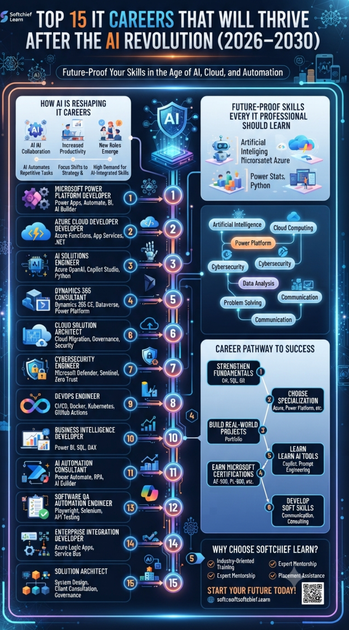
In this guide, we’ll explore 15 IT careers that are expected to remain in strong demand between 2026 and 2030, along with the skills, certifications, and career paths needed to succeed.
How AI Is Changing the IT Industry
Rather than replacing technology professionals, AI is reshaping job roles.
Professionals who embrace AI will likely become more productive by:
- Automating repetitive coding tasks
- Generating documentation
- Accelerating testing
- Improving debugging
- Enhancing customer support
- Building intelligent applications
- Creating AI-powered workflows
The future belongs to professionals who combine technical expertise with AI capabilities.
1. Microsoft Power Platform Developer
Power Platform has become one of Microsoft’s fastest-growing technologies.
Organizations use it to:
- Build business applications
- Automate workflows
- Create enterprise portals
- Generate business insights
- Develop AI-powered business solutions
Key Skills
- Power Apps
- Power Automate
- Power BI
- Power Pages
- Dataverse
- Copilot Studio
- AI Builder
- C#
- JavaScript
- Azure
Recommended Certifications
- PL-900
- PL-400
Career Outlook
Excellent demand across consulting companies and enterprise organizations implementing digital transformation initiatives.
2. Azure Cloud Developer
Cloud adoption continues to accelerate globally.
Azure Developers build secure, scalable, cloud-native applications using Microsoft Azure services.
Skills
- Azure Functions
- Azure App Services
- Azure Storage
- Azure SQL
- Azure Identity
- REST APIs
- Containers
- .NET
Certifications
- AZ-900
- AZ-204
3. AI Solutions Engineer
Organizations increasingly require professionals who can integrate AI into business applications.
Typical responsibilities include:
- Building AI assistants
- Integrating Large Language Models (LLMs)
- Implementing Retrieval-Augmented Generation (RAG)
- Prompt engineering
- AI orchestration
- Intelligent automation
Skills
- Azure OpenAI
- Copilot Studio
- Python
- APIs
- Prompt Engineering
- AI Builder
4. Dynamics 365 Consultant
Businesses continue to invest in CRM and ERP modernization.
Dynamics 365 professionals help organizations implement, customize, and optimize enterprise applications.
Skills
- Dynamics 365 CE
- Dataverse
- Power Platform
- Plugins
- JavaScript
- Power Automate
Demand remains strong in consulting, finance, healthcare, manufacturing, and retail.
5. Full Stack Developer
Despite AI-assisted coding, organizations still need developers who can design, build, deploy, and maintain complete applications.
Skills
- HTML
- CSS
- JavaScript
- React
- Angular
- ASP.NET Core
- Node.js
- SQL
- Azure
AI enhances developer productivity but does not replace architectural thinking or business problem-solving.
6. Cloud Solution Architect
Cloud architects design enterprise-scale systems that are secure, scalable, and cost-effective.
Responsibilities
- Cloud migration
- Architecture design
- Security
- Disaster recovery
- Cost optimization
- Governance
This role requires strong technical and business understanding.
7. Cybersecurity Engineer
As AI increases digital complexity, cybersecurity becomes even more critical.
Professionals protect organizations from:
- Ransomware
- Data breaches
- Identity attacks
- Cloud threats
- AI-assisted cyberattacks
Skills
- Microsoft Defender
- Microsoft Sentinel
- Azure Security
- Identity Management
- Zero Trust Architecture
8. Data Engineer
AI systems rely on high-quality data.
Data Engineers build the pipelines that collect, transform, and prepare data for analytics and machine learning.
Skills
- SQL
- Azure Data Factory
- Synapse Analytics
- Spark
- Data Warehousing
- ETL
9. DevOps Engineer
Continuous delivery remains essential.
DevOps professionals automate:
- Deployments
- Infrastructure
- Monitoring
- CI/CD pipelines
- Configuration management
Skills
- Azure DevOps
- GitHub Actions
- Docker
- Kubernetes
- Terraform
- PowerShell
10. Business Intelligence Developer
Organizations need professionals who transform raw data into actionable insights.
Skills
- Power BI
- SQL
- DAX
- Data Modeling
- Visualization
- Business Analytics
Decision-makers increasingly rely on data-driven strategies.
11. AI Automation Consultant
Businesses want to automate repetitive work using AI.
Responsibilities include:
- Workflow automation
- Copilot implementation
- AI-powered approvals
- Process optimization
- Robotic Process Automation (RPA)
Power Automate and AI Builder are key technologies in this field.
12. Microsoft 365 & Copilot Consultant
Microsoft 365 Copilot is changing workplace productivity.
Consultants help organizations:
- Deploy Copilot
- Configure security
- Optimize collaboration
- Improve productivity
- Train users
Demand for this role is expected to grow as AI adoption expands.
13. Software Quality Assurance (QA) Automation Engineer
AI can generate tests, but organizations still require professionals to validate business scenarios and ensure software quality.
Skills
- Playwright
- Selenium
- API Testing
- Automation Frameworks
- Performance Testing
Testing remains a critical component of software delivery.
14. Enterprise Integration Developer
Modern organizations depend on interconnected systems.
Integration specialists connect:
- ERP systems
- CRM platforms
- APIs
- Cloud services
- Third-party applications
Technologies include:
- Azure Logic Apps
- Service Bus
- API Management
- REST APIs
- Event Grid
15. Solution Architect
Solution Architects combine technical expertise with business strategy.
Responsibilities include:
- Solution design
- Client consultation
- Technology selection
- Cost estimation
- Governance
- Team leadership
This is one of the most respected and rewarding career paths in enterprise IT.
Future-Proof Skills Every IT Professional Should Learn
Regardless of your specialization, the following skills will remain valuable:
- Artificial Intelligence
- Cloud Computing
- Microsoft Azure
- Power Platform
- Cybersecurity Fundamentals
- SQL
- APIs
- Git
- Problem Solving
- Communication
- Business Analysis
Technical expertise combined with strong soft skills creates long-term career resilience.
Microsoft Technologies That Will Continue Growing
Microsoft continues to invest heavily in enterprise technologies, making these platforms particularly attractive for long-term careers:
- Microsoft Power Platform
- Dynamics 365
- Azure
- Microsoft Fabric
- Copilot Studio
- Azure AI Services
- Microsoft 365
- Microsoft Security
- Dataverse
Learning these technologies can position professionals for roles across multiple industries.
Salary Outlook in India (2026–2030)
Approximate annual salary ranges vary by experience, location, and employer.
| Career | Fresher | Experienced |
|---|---|---|
| Power Platform Developer | ₹4 – ₹8 LPA | ₹15 – ₹30+ LPA |
| Azure Developer | ₹5 – ₹10 LPA | ₹18 – ₹35+ LPA |
| Dynamics 365 Consultant | ₹5 – ₹9 LPA | ₹18 – ₹35+ LPA |
| Full Stack Developer | ₹4 – ₹8 LPA | ₹18 – ₹40+ LPA |
| Cloud Architect | ₹10 – ₹18 LPA | ₹35 – ₹60+ LPA |
| Cybersecurity Engineer | ₹5 – ₹10 LPA | ₹20 – ₹40+ LPA |
| Data Engineer | ₹6 – ₹10 LPA | ₹20 – ₹40+ LPA |
| Solution Architect | ₹12 – ₹20 LPA | ₹40 – ₹70+ LPA |
These are indicative ranges and can vary based on expertise, certifications, company size, and project experience.
How to Prepare for an AI-Driven IT Career
A practical roadmap for students and professionals:
Step 1
Strengthen programming fundamentals.
Learn:
- C#
- SQL
- JavaScript
- APIs
Step 2
Choose one specialization.
Examples:
- Power Platform
- Azure
- Full Stack Development
- Dynamics 365
Step 3
Build real-world projects.
Employers value practical experience.
Step 4
Earn relevant Microsoft certifications.
Examples:
- PL-900
- PL-400
- AZ-900
- AZ-204
Step 5
Learn AI tools.
Understand:
- Microsoft Copilot
- Azure OpenAI
- Prompt Engineering
- AI Builder
- Copilot Studio
Step 6
Develop communication and consulting skills.
Technical expertise alone is no longer enough.
Common Myths About AI and IT Careers
Myth 1: AI Will Replace All Developers
Reality: AI assists developers but still requires human expertise for architecture, design, security, integration, and business decision-making.
Myth 2: Coding Is Becoming Obsolete
Reality: Programming remains a core skill. AI-generated code still needs review, testing, optimization, and customization.
Myth 3: Only AI Engineers Will Have Jobs
Reality: Cloud computing, cybersecurity, enterprise applications, consulting, DevOps, and data engineering continue to experience strong demand alongside AI.
Frequently Asked Questions (FAQs)
1. Will AI replace software developers by 2030?
AI is expected to automate many repetitive development tasks, but software developers will continue to play a vital role in designing systems, solving business problems, ensuring quality, and integrating AI into enterprise solutions.
2. Which IT career is most future-proof?
There isn’t a single “best” option. Careers in Power Platform, Azure, Cloud Architecture, Cybersecurity, AI Solutions Engineering, Data Engineering, and Solution Architecture all show strong long-term potential.
3. Which Microsoft technology should freshers learn?
For beginners, Microsoft Power Platform and Azure Fundamentals provide excellent entry points. As your skills grow, you can specialize in Dynamics 365, Azure Development, or AI solutions.
4. Should I still learn programming if AI can write code?
Yes. Understanding programming concepts is essential for reviewing AI-generated code, solving complex problems, building secure applications, and designing scalable systems.
5. How can I prepare for future IT jobs?
Focus on building strong fundamentals, mastering one specialization, gaining cloud and AI knowledge, earning relevant certifications, creating real-world projects, and continuously learning as technologies evolve.
Final View
The AI revolution is changing the IT landscape, but it is creating new opportunities rather than eliminating careers. Professionals who combine technical expertise with AI, cloud computing, automation, and business understanding will remain in high demand throughout the coming years.
Instead of worrying about whether AI will replace your job, focus on becoming the kind of professional who can work effectively with AI, solve real business challenges, and deliver innovative solutions.
The future belongs to learners who continuously adapt, upskill, and embrace change.
Why Build Your Future with Softchief Learn?
At Softchief Learn, we help students, freshers, and working professionals prepare for the future of enterprise technology through practical, industry-oriented training.
Our programs cover:
- Microsoft Power Platform
- Microsoft Dynamics 365 CE
- Microsoft Azure
- C# .NET Full Stack Development
- AI & Copilot Integration
- Real-Time Industry Projects
- Resume Building
- Mock Interviews
- Placement Assistance
- Lifetime Learning Resources
Designed and delivered by experienced Microsoft-certified professionals, our courses help you develop the practical skills required to succeed in an AI-driven technology landscape.
Conclusion
Artificial Intelligence is reshaping the future of IT, but it is not replacing the need for skilled professionals. Careers in cloud computing, enterprise applications, cybersecurity, software engineering, data engineering, AI integration, and solution architecture will continue to grow as businesses embrace digital transformation.
The key to long-term career success is not resisting AI—it’s learning how to leverage it. By mastering in-demand Microsoft technologies, building practical experience, earning relevant certifications, and developing a continuous learning mindset, you can position yourself for a rewarding career between 2026 and 2030 and beyond.