
Dynamics 365 vs Salesforce: Which CRM Career Is Better for Freshers in 2026?
Introduction
Customer Relationship Management (CRM) has become one of the most important areas of enterprise technology. Organizations across industries use CRM platforms to manage sales, customer service, marketing, field operations, and customer engagement.
When students and fresh graduates decide to build a CRM career, one question often comes up:
“Should I learn Microsoft Dynamics 365 or Salesforce?”
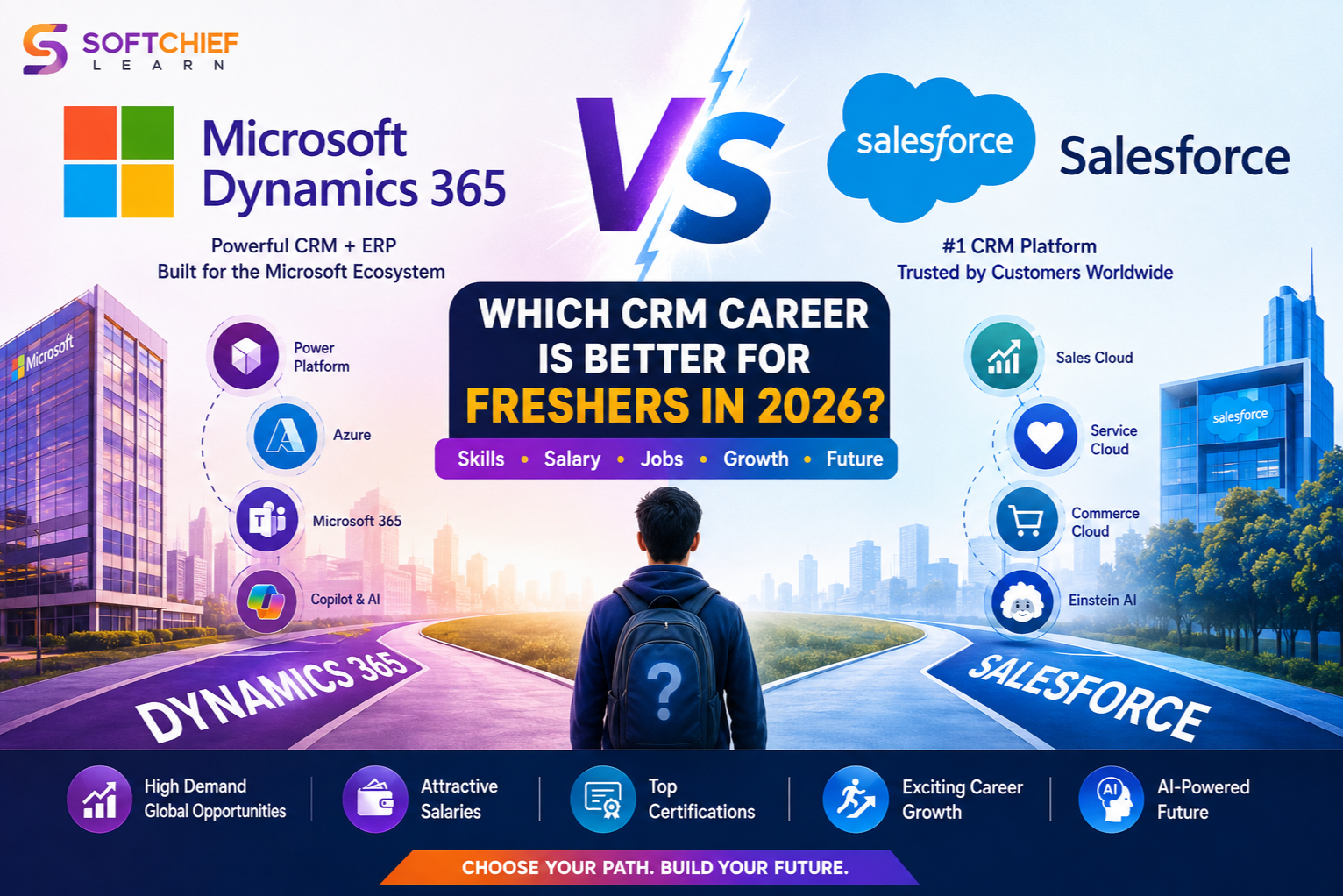
Both platforms are industry leaders with global adoption, excellent salaries, and strong career prospects. However, they differ significantly in terms of ecosystem, learning curve, technology stack, certifications, and career opportunities.
If you’re planning your career in 2026, this guide compares Microsoft Dynamics 365 and Salesforce to help you choose the path that best matches your goals.
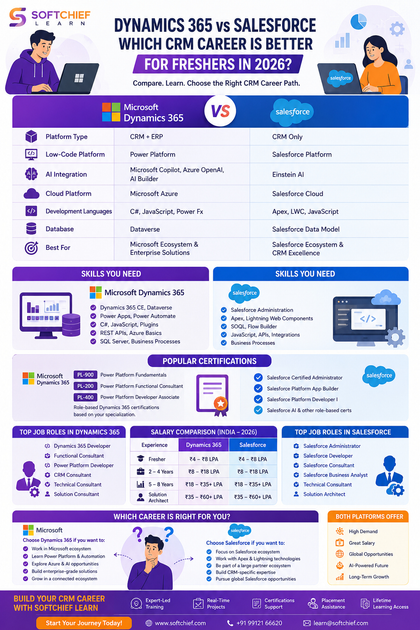
What Is Microsoft Dynamics 365?
Microsoft Dynamics 365 is Microsoft’s cloud-based suite of intelligent business applications that combines CRM (Customer Relationship Management) and ERP (Enterprise Resource Planning) capabilities.
Organizations use Dynamics 365 to manage:
- Sales
- Customer Service
- Marketing
- Field Service
- Customer Insights
- Finance
- Supply Chain
- Project Operations
One of its biggest strengths is its seamless integration with:
- Microsoft Power Platform
- Microsoft Azure
- Microsoft 365
- Microsoft Teams
- Copilot
- Dataverse
This makes Dynamics 365 a central part of the Microsoft business ecosystem.
What Is Salesforce?
Salesforce is one of the world’s most widely used cloud CRM platforms.
It helps businesses manage:
- Sales
- Service
- Marketing
- Commerce
- Analytics
- Customer Engagement
Salesforce also offers a large ecosystem of cloud products and development tools, making it a popular choice for enterprises worldwide.
Why CRM Careers Are Growing
Digital transformation has made CRM systems essential for organizations of all sizes.
Businesses increasingly rely on CRM platforms to:
- Improve customer relationships
- Increase sales productivity
- Automate business processes
- Deliver personalized customer experiences
- Analyze customer data
- Support AI-driven decision-making
As CRM adoption grows, so does the demand for skilled consultants, developers, administrators, and architects.
Dynamics 365 vs Salesforce: Quick Comparison
| FeatureMicrosoft Dynamics 365Salesforce | ||
|---|---|---|
| Vendor | Microsoft | Salesforce |
| Platform Type | CRM + ERP | CRM |
| Low-Code Platform | Power Platform | Salesforce Platform |
| AI Integration | Microsoft Copilot, Azure OpenAI | Einstein AI |
| Cloud Platform | Microsoft Azure | Salesforce Cloud |
| Development Languages | C#, JavaScript, Power Fx | Apex, Lightning Web Components (LWC), JavaScript |
| Database | Dataverse | Salesforce Data Model |
| Productivity Integration | Microsoft 365, Teams, Outlook | Salesforce Ecosystem |
| Best For | Microsoft Enterprise Ecosystem | Salesforce Enterprise Ecosystem |
Learning Curve
Microsoft Dynamics 365
Freshers often find Dynamics 365 easier if they already know Microsoft technologies such as:
- Power Apps
- Power Automate
- C#
- SQL
- Azure
- Microsoft 365
The shared Microsoft ecosystem reduces the learning curve.
Salesforce
Salesforce introduces platform-specific technologies such as:
- Apex
- Lightning Web Components
- SOQL
- Flow Builder
- Salesforce Administration
Although beginner-friendly resources are available, developers often need to learn technologies unique to Salesforce.
Skills Required
Dynamics 365 Career
Technical skills include:
- Dynamics 365 CE
- Dataverse
- Power Apps
- Power Automate
- JavaScript
- C#
- Plugins
- REST APIs
- Azure Basics
- SQL Server
Business understanding is equally important because many implementations involve customer-facing processes.
Salesforce Career
Key skills include:
- Salesforce Administration
- Apex
- Lightning Web Components
- SOQL
- Flows
- Visualforce (legacy environments)
- JavaScript
- Integrations
- APIs
Knowledge of CRM processes is also valuable.
AI and Future Readiness
Artificial Intelligence is reshaping enterprise CRM platforms.
Microsoft Dynamics 365
Microsoft has deeply integrated AI across its ecosystem through:
- Microsoft Copilot
- Copilot Studio
- Azure OpenAI
- AI Builder
- Power Platform
Examples include:
- AI-generated emails
- Sales summaries
- Opportunity insights
- Intelligent automation
- Customer sentiment analysis
The close integration with Azure AI services gives Dynamics 365 professionals opportunities to work on AI-powered enterprise solutions.
Salesforce
Salesforce offers AI capabilities through Einstein AI, which supports:
- Sales forecasting
- Lead scoring
- Customer recommendations
- Service automation
- AI-assisted workflows
Both ecosystems are investing heavily in AI, making AI literacy valuable regardless of the platform you choose.
Certifications
Microsoft Dynamics 365
Popular certifications include:
Beginner
- PL-900 – Microsoft Power Platform Fundamentals
Intermediate
- PL-200 – Power Platform Functional Consultant
- PL-400 – Power Platform Developer Associate
Role-based Dynamics 365 certifications can then be pursued based on your specialization.
Salesforce
Common certifications include:
- Salesforce Certified Administrator
- Salesforce Platform App Builder
- Salesforce Platform Developer I
- Salesforce AI-related certifications
Choose certifications that align with your intended career path.
Job Roles
Dynamics 365
Common roles include:
- Dynamics 365 Developer
- Dynamics 365 Functional Consultant
- Power Platform Developer
- CRM Consultant
- Technical Consultant
- Solution Consultant
- Business Applications Consultant
Salesforce
Career opportunities include:
- Salesforce Administrator
- Salesforce Developer
- Salesforce Consultant
- Salesforce Business Analyst
- Technical Consultant
- Solution Architect
Both ecosystems offer diverse career paths, though the technologies involved differ.
Salary Comparison (India – 2026)
Approximate salary ranges vary based on company, location, certifications, and experience.
| ExperienceDynamics 365Salesforce | ||
|---|---|---|
| Fresher | ₹4 – ₹8 LPA | ₹4 – ₹8 LPA |
| 2–4 Years | ₹8 – ₹18 LPA | ₹8 – ₹18 LPA |
| 5–8 Years | ₹18 – ₹35+ LPA | ₹18 – ₹35+ LPA |
| Solution Architect | ₹35 – ₹60+ LPA | ₹35 – ₹60+ LPA |
Salary growth depends more on practical expertise, project experience, and specialization than on the platform alone.
Global Demand
Both technologies enjoy strong global demand.
Dynamics 365
Demand is growing rapidly because organizations are adopting:
- Microsoft 365
- Azure
- Power Platform
- Copilot
- Dynamics 365
This creates opportunities for professionals who understand multiple Microsoft technologies.
Salesforce
Salesforce has a large global customer base and a mature ecosystem with consistent demand across consulting firms and enterprise organizations.
Which Platform Is Easier for Freshers?
If you’re new to IT:
Dynamics 365 may be a smoother entry if you:
- Want to learn Power Platform
- Plan to work with Microsoft technologies
- Already know C# or .NET
- Want to explore Azure and AI later
Salesforce may suit you if you:
- Want to specialize in the Salesforce ecosystem
- Prefer learning Apex and Lightning technologies
- Are interested in Salesforce-specific consulting and development roles
There is no universally “easier” platform—it depends on your interests and long-term goals.
Career Growth Opportunities
Dynamics 365 Career Path
- Power Platform Developer
- Dynamics 365 Developer
- Technical Consultant
- Solution Consultant
- Solution Architect
- Practice Lead
You can also expand into Azure, AI, and enterprise integrations.
Salesforce Career Path
- Salesforce Administrator
- Salesforce Developer
- Senior Consultant
- Technical Architect
- Solution Architect
- Practice Manager
Both ecosystems provide long-term growth for professionals who continuously learn.
Which Ecosystem Is Better for AI?
Microsoft’s strength lies in the integration between:
- Dynamics 365
- Power Platform
- Microsoft Copilot
- Azure OpenAI
- Microsoft 365
This unified ecosystem enables professionals to work across CRM, low-code development, cloud services, and AI.
Salesforce continues to enhance its platform with Einstein AI, offering intelligent CRM capabilities within its own ecosystem.
If your goal is broader exposure to Microsoft’s cloud, automation, and AI technologies, Dynamics 365 provides a naturally connected pathway.
Which Career Should You Choose?
Choose Microsoft Dynamics 365 if you want to:
- Build expertise in Microsoft technologies
- Learn Power Platform alongside CRM
- Expand into Azure and AI
- Develop enterprise applications
- Work with Microsoft’s integrated ecosystem
Choose Salesforce if you want to:
- Focus primarily on the Salesforce platform
- Build expertise in Apex and Lightning
- Work within Salesforce’s extensive partner ecosystem
- Pursue Salesforce-specific consulting opportunities
The right choice depends on your career vision rather than one platform being objectively superior.
Common Mistakes Freshers Make
Avoid these common pitfalls:
- Choosing a platform based only on salary claims
- Ignoring practical projects
- Skipping certifications
- Learning too many technologies simultaneously
- Neglecting communication skills
- Relying solely on theory
Practical implementation and continuous learning are key to long-term success.
Final Thoughts
Both Microsoft Dynamics 365 and Salesforce are excellent platforms for building a successful CRM career. The best choice depends on your interests, the technologies you enjoy, and the ecosystem you want to work in.
If you’re excited by Microsoft’s integrated approach—combining CRM, low-code development, cloud computing, and AI—Dynamics 365, together with Power Platform and Azure, offers a broad and future-ready career path. If your passion lies in Salesforce’s dedicated CRM ecosystem, it remains one of the strongest enterprise platforms with global opportunities.
Whichever platform you choose, focus on practical projects, certifications, business understanding, and continuous learning. Those factors will have the greatest impact on your career growth.
Why Learn Microsoft Dynamics 365 with Softchief Learn?
At Softchief Learn, we help students, freshers, and working professionals build industry-ready careers in the Microsoft ecosystem through practical, expert-led training.
Our programs include:
- Microsoft Dynamics 365 CE
- Microsoft Power Platform
- Power Apps
- Power Automate
- Microsoft Dataverse
- Microsoft Azure
- AI & Copilot Integration
- C# .NET Full Stack Development
- Real-Time Industry Projects
- Resume Building
- Mock Interviews
- Placement Assistance
- Lifetime Learning Resources
Our curriculum emphasizes hands-on implementation, ensuring you’re prepared for both certifications and real-world enterprise projects.
Conclusion
Choosing between Dynamics 365 and Salesforce isn’t about finding a universally better platform—it’s about selecting the ecosystem that aligns with your career aspirations.
For freshers interested in Microsoft’s expanding ecosystem of Power Platform, Azure, Copilot, and enterprise AI, Dynamics 365 offers an integrated path with opportunities to diversify into multiple technologies. Salesforce remains a powerful choice for professionals committed to its specialized CRM ecosystem.
Whichever direction you choose, invest in building practical experience, earning relevant certifications, and staying current with AI-driven innovations. Those who continuously upskill will be well-positioned for long-term success in the evolving CRM industry.