Dynamics 365 CE vs Finance & Operations: Which Microsoft Dynamics 365 Career Path Should You Choose in 2026?
Introduction
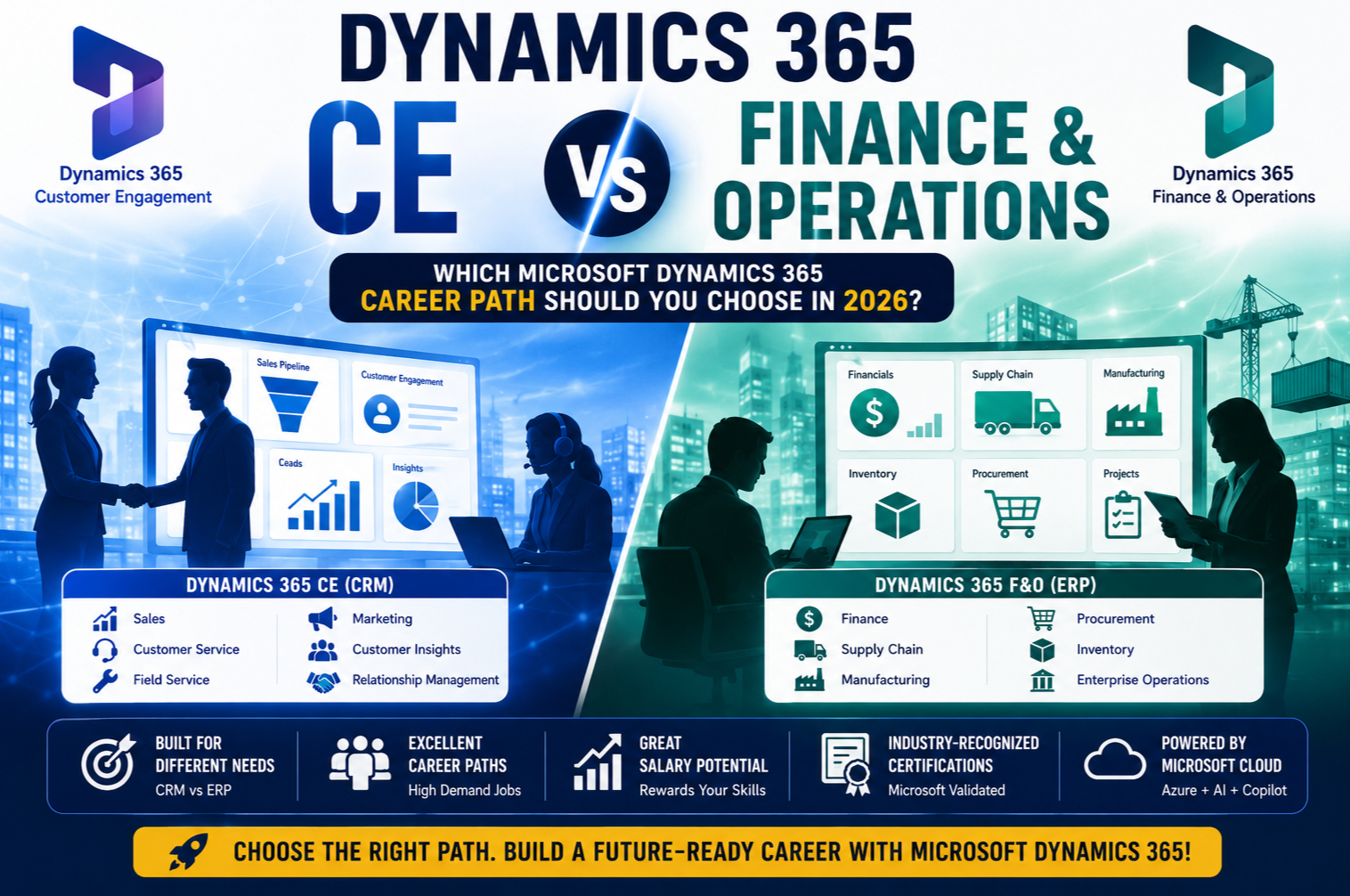
Microsoft Dynamics 365 is one of the world’s leading enterprise business application platforms, offering specialized solutions for Customer Relationship Management (CRM) and Enterprise Resource Planning (ERP). Among its most popular products are Dynamics 365 Customer Engagement (CE) and Dynamics 365 Finance & Operations (F&O).
Although both belong to the Dynamics 365 ecosystem, they solve completely different business problems and require different technical skills.
This often raises questions such as:
- Is Dynamics 365 CE the same as Finance & Operations?
- Which platform offers better career opportunities?
- Which one should developers learn?
- Which solution is best for businesses?
In this comprehensive guide, we’ll compare Dynamics 365 CE and Finance & Operations from business, technical, and career perspectives to help you make an informed decision.
What is Dynamics 365 Customer Engagement (CE)?
Dynamics 365 Customer Engagement (CE) is Microsoft’s cloud-based CRM (Customer Relationship Management) platform designed to help organizations manage customer interactions, sales, marketing, customer service, and field operations.
Its primary objective is to improve customer satisfaction, strengthen customer relationships, and increase sales efficiency.
Core Applications
- Dynamics 365 Sales
- Dynamics 365 Customer Service
- Dynamics 365 Field Service
- Dynamics 365 Customer Insights
- Dynamics 365 Contact Center
- Dynamics 365 Project Operations
Business Functions
- Lead Management
- Opportunity Management
- Sales Pipeline
- Customer Service
- Case Management
- Field Service Scheduling
- Customer Engagement
- Relationship Management
What is Dynamics 365 Finance & Operations?
Dynamics 365 Finance & Operations (F&O) is Microsoft’s enterprise ERP solution built for medium and large organizations. It enables businesses to manage finance, manufacturing, supply chain, procurement, human resources, retail, and global business operations.
Unlike Business Central, Finance & Operations is designed for complex enterprise environments with multi-company, multi-currency, and global compliance requirements.
Core Modules
- Finance
- Supply Chain Management
- Procurement
- Manufacturing
- Warehouse Management
- Asset Management
- Project Operations
- Commerce
- Human Resources (separate application)
- Budget Planning
Business Functions
- Financial Accounting
- Cost Management
- Inventory Control
- Manufacturing Planning
- Procurement
- Global Compliance
- Supply Chain Management
- Enterprise Operations
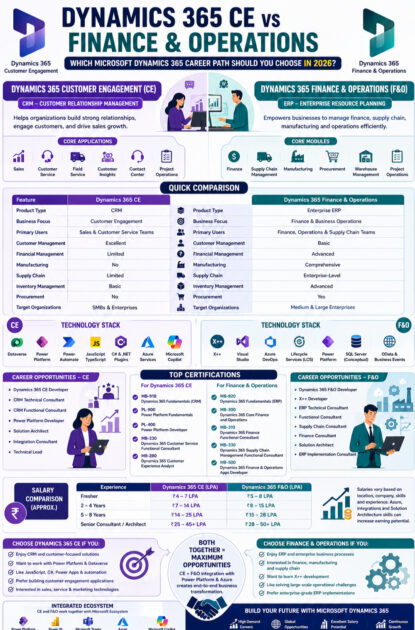
Dynamics 365 CE vs Finance & Operations: Quick Comparison
| Feature | Dynamics 365 CE | Dynamics 365 Finance & Operations |
|---|---|---|
| Product Type | CRM | Enterprise ERP |
| Business Focus | Customer Engagement | Finance & Business Operations |
| Primary Users | Sales & Customer Service Teams | Finance, Operations & Supply Chain Teams |
| Customer Management | Excellent | Basic |
| Financial Management | Limited | Advanced |
| Manufacturing | No | Comprehensive |
| Supply Chain | Limited | Enterprise-Level |
| Inventory Management | Basic | Advanced |
| Procurement | No | Yes |
| Target Organizations | SMBs & Enterprises | Medium & Large Enterprises |
CRM vs ERP: The Fundamental Difference
Understanding CRM and ERP is the key to choosing the right platform.
Dynamics 365 CE (CRM)
CRM focuses on:
- Managing customer relationships
- Improving sales
- Customer support
- Marketing automation
- Lead nurturing
- Service management
It primarily supports customer-facing teams.
Dynamics 365 Finance & Operations (ERP)
ERP focuses on:
- Financial management
- Manufacturing
- Supply chain
- Procurement
- Warehouse operations
- Budget planning
- Business operations
It primarily supports internal business operations.
Functional Comparison
Dynamics 365 CE Features
Sales
- Lead Management
- Opportunity Tracking
- Quotes
- Forecasting
- Customer Accounts
Customer Service
- Case Management
- Knowledge Base
- SLA Management
- Omnichannel Support
Field Service
- Work Orders
- Resource Scheduling
- Mobile Workforce
- Asset Tracking
Customer Insights
- Customer Analytics
- Segmentation
- Journey Management
Finance & Operations Features
Finance
- General Ledger
- Accounts Payable
- Accounts Receivable
- Budgeting
- Fixed Assets
- Cash Management
Supply Chain
- Inventory
- Procurement
- Warehouse
- Transportation
- Logistics
Manufacturing
- Production Planning
- Bill of Materials
- Capacity Planning
- Shop Floor Control
Enterprise Operations
- Multi-company Management
- Global Taxation
- Financial Reporting
- Compliance
Technical Comparison
Dynamics 365 CE Technology Stack
Developers commonly work with:
- Microsoft Dataverse
- Power Apps
- Power Automate
- Power Pages
- JavaScript
- TypeScript
- C#
- .NET Plugins
- PCF Controls
- Web API
- Azure Services
- Microsoft Copilot
Customization is highly focused on customer-facing applications and business processes.
Dynamics 365 Finance & Operations Technology Stack
F&O developers primarily use:
- X++
- Visual Studio
- Azure DevOps
- Lifecycle Services (LCS)
- Electronic Reporting (ER)
- Data Management Framework (DMF)
- Power Platform
- SQL Server (conceptual understanding)
- Azure Services
- OData
- Business Events
Development in F&O revolves around extending ERP functionality while following Microsoft’s extension model to ensure seamless upgrades.
Development & Customization
Dynamics 365 CE
Customization options include:
- Custom Tables
- Business Rules
- JavaScript
- Plugins
- Power Automate
- PCF Controls
- Custom APIs
- Azure Functions
- Dataverse
Ideal for creating customer-centric applications and automating business processes.
Finance & Operations
Customization options include:
- X++ Development
- Form Extensions
- Table Extensions
- Class Extensions
- SSRS Reports
- Batch Jobs
- Workflows
- Data Entities
- Business Events
- Electronic Reporting
F&O development is geared toward enterprise-scale business logic and operational processes.
Integration with Microsoft Ecosystem
Dynamics 365 CE integrates with:
- Power Apps
- Power Automate
- Power BI
- Microsoft Teams
- Outlook
- SharePoint
- Azure
- Microsoft Copilot
- Dynamics 365 Finance
Finance & Operations integrates with:
- Power BI
- Power Automate
- Microsoft Teams
- Excel
- Azure
- Dynamics 365 CE
- Microsoft Copilot
- Electronic Reporting
- Lifecycle Services
Many organizations integrate CE and Finance & Operations to create a unified business platform where sales, finance, and operations work together seamlessly.
Career Opportunities
Dynamics 365 CE Careers
- Dynamics 365 CE Developer
- CRM Technical Consultant
- CRM Functional Consultant
- Power Platform Developer
- Solution Architect
- Integration Consultant
- Technical Lead
Finance & Operations Careers
- Dynamics 365 F&O Developer
- X++ Developer
- ERP Technical Consultant
- Functional Consultant
- Supply Chain Consultant
- Finance Consultant
- Solution Architect
- ERP Implementation Consultant
Both domains offer excellent opportunities with Microsoft partners, consulting firms, ISVs, and multinational enterprises.
Certifications
Dynamics 365 CE Certifications
Recommended certifications include:
- MB-910: Dynamics 365 Fundamentals (CRM)
- PL-900: Microsoft Power Platform Fundamentals
- PL-400: Microsoft Power Platform Developer
- MB-230: Dynamics 365 Customer Service Functional Consultant
- MB-280: Dynamics 365 Customer Experience Analyst
Finance & Operations Certifications
Recommended certifications include:
- MB-920: Dynamics 365 Fundamentals (ERP)
- MB-300: Microsoft Dynamics 365 Core Finance and Operations
- MB-310: Dynamics 365 Finance Functional Consultant
- MB-330: Dynamics 365 Supply Chain Management Functional Consultant
- MB-500: Dynamics 365 Finance & Operations Apps Developer
Salary Comparison
(Approximate salaries vary depending on location, company, and experience.)
| Experience | Dynamics 365 CE | Dynamics 365 Finance & Operations |
|---|---|---|
| Fresher | ₹4–7 LPA | ₹5–8 LPA |
| 2–4 Years | ₹7–14 LPA | ₹8–15 LPA |
| 5–8 Years | ₹14–25 LPA | ₹15–28 LPA |
| Senior Consultant / Architect | ₹25–45+ LPA | ₹28–50+ LPA |
Professionals with expertise in Azure, integrations, AI, and Solution Architecture often earn premium compensation in both domains.
Which Platform is Better for Businesses?
Choose Dynamics 365 CE if your business wants to:
- Increase sales performance
- Improve customer service
- Manage customer relationships
- Automate sales processes
- Enhance customer engagement
- Optimize field service operations
Choose Dynamics 365 Finance & Operations if your business needs to:
- Manage enterprise finance
- Control supply chains
- Optimize manufacturing
- Improve procurement
- Handle multi-company operations
- Meet global compliance requirements
Many enterprises deploy both solutions together for complete digital transformation.
Which Career Path Should You Choose?
Choose Dynamics 365 CE if you:
- Enjoy CRM and customer-focused solutions.
- Want to work with Power Platform and Dataverse.
- Like JavaScript, C#, Power Apps, and automation.
- Prefer building customer engagement applications.
- Are interested in sales, service, and marketing technologies.
Choose Dynamics 365 Finance & Operations if you:
- Enjoy ERP and enterprise business processes.
- Are interested in finance, manufacturing, and supply chain.
- Want to learn X++ development.
- Like solving large-scale operational challenges.
- Prefer working on enterprise-grade ERP implementations.
Professionals who understand both CRM and ERP concepts—and know how CE integrates with Finance & Operations through Power Platform and Azure—are highly sought after for Solution Architect and enterprise consulting roles.
Conclusion
Dynamics 365 CE and Dynamics 365 Finance & Operations are complementary solutions that address different aspects of business transformation. CE helps organizations strengthen customer relationships, improve sales performance, and deliver exceptional service, while Finance & Operations streamlines finance, supply chain, manufacturing, and enterprise operations.
As Microsoft continues to invest in AI, Copilot, Azure, and the Power Platform ecosystem, professionals who understand both CRM and ERP technologies will be well-positioned for high-impact roles in digital transformation. Whether you specialize in Dynamics 365 CE, Finance & Operations, or both, mastering these enterprise platforms can lead to rewarding careers with Microsoft partners, global consulting firms, and enterprise organizations.